Cardioverter ICD-10 Code: AICD Status, Placement & Billing Guide
November 13, 2026
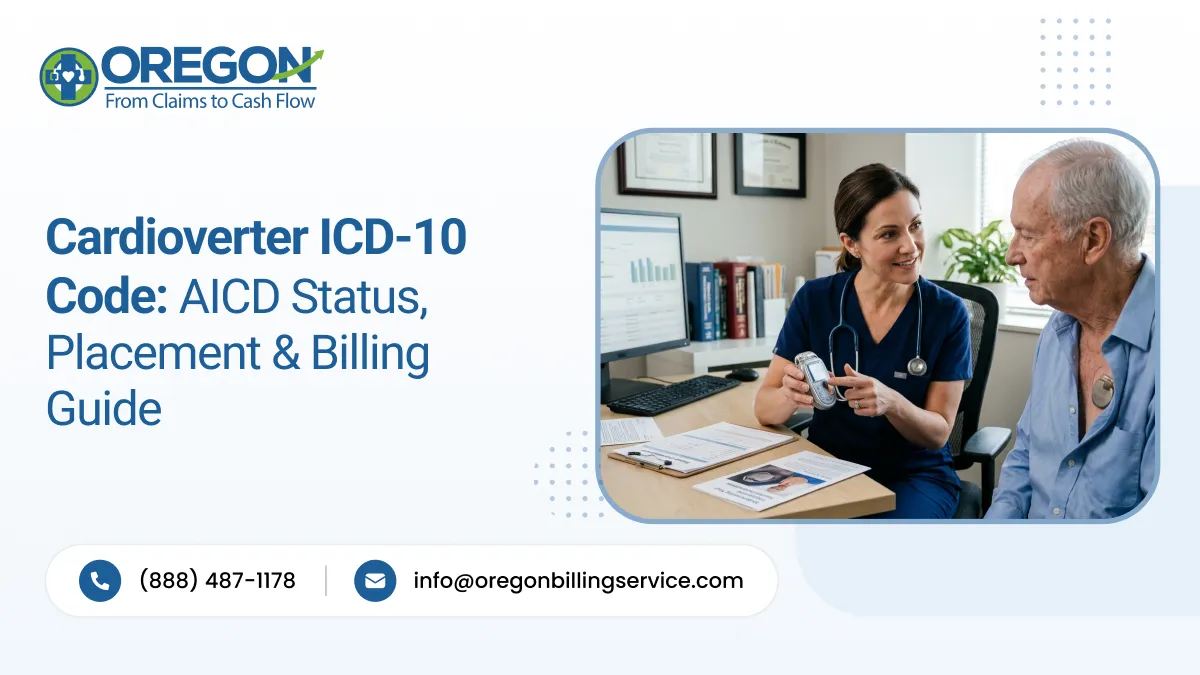
The Cardioverter ICD-10 code is Z95.810, which identifies the presence of an automatic implantable cardiac defibrillator (AICD). Healthcare providers use this code when a patient’s implanted defibrillator status is relevant to the encounter.
However, ICD placement, device interrogation, generator replacement, and complications can require different codes. Selecting the wrong diagnosis or overlooking documentation requirements can create avoidable claim denials.
This guide explains the correct cardioverter ICD-10-CM codes, practical coding scenarios, Medicare coverage requirements, and billing issues that healthcare providers should review before submitting claims.
Z95.810 — Presence of automatic (implantable) cardiac defibrillator is the billable ICD-10-CM diagnosis code for an implanted cardioverter-defibrillator. It belongs to category Z95, which identifies the presence of cardiac and vascular implants and grafts.
It may be used when the device is affecting patient care or it is required to include the relevant diagnosis. This includes implantable defibrillators (ICD, AICD, CRT-D) and implantable defibrillators with synchronized pacing function.
This code does not provide any information about the cardiac condition. For example, if a patient has an ICD and is being treated for heart failure by a cardiologist then the documented cardiac condition may be the first listed diagnosis. However this code can provide additional relevant information.
The correct ICD-10 code for a cardiac device depends on whether the patient has a pacemaker, implanted defibrillator, or another device, as well as the purpose of the encounter.
| ICD-10-CM Code | Description | When It Applies |
|---|---|---|
| Z95.810 | Presence of automatic implantable cardiac defibrillator | ICD, AICD, or CRT-D status |
| Z95.0 | Presence of cardiac pacemaker | Permanent pacemaker status |
| Z45.02 | Encounter for adjustment and management of automatic implantable cardiac defibrillator | ICD management |
| Z45.010 | Encounter for checking and testing of cardiac pacemaker pulse generator | Pacemaker generator checking |
| Z45.018 | Encounter for adjustment and management of other part of cardiac pacemaker | Other pacemaker management |
Single chamber pacemaker would be coded as Z95.0. ICD would be coded as Z95.810. CRT-D devices are a dual function device so are also coded as Z95.810. CRT-P devices are just a pacemaker so will generally be coded as such.
If the provider mentions that the patient has had pacing and defibrillation then you need to check whether they have a dual device or two separate ones.
These codes address different circumstances. Z95.810 identifies implanted defibrillator status, while Z45.02 identifies an encounter for adjustment and management of an automatic implantable cardiac defibrillator.
The patient management has a functional ICD. They attend their cardiologist to manage their heart failure. No specific device has taken place therefore the clinician may list Z95.810 as an additional diagnosis if the device is impacting on their management.
The patient attends a planned follow-up appointment. The cardiologist will interrogate the device. This includes reviewing device memory and battery levels. Z45.02 can be used to indicate the management of the device if the documentation supports this.
The key difference: Device presence alone does not mean the encounter involved device adjustment or management.
There is no single ICD-10-CM diagnosis code for every defibrillator implantation. Providers must identify the documented medical indication and report the appropriate procedure code for the treatment setting.
| ICD-10-CM Code | Diagnosis |
| I47.20 | Ventricular tachycardia, unspecified |
| I49.01 | Ventricular fibrillation |
| I42.0 | Dilated cardiomyopathy |
| I50.- | Heart failure, requiring a more specific code |
| Z86.74 | Personal history of sudden cardiac arrest |
These are potential coding considerations. You will need to ensure that the medical evidence provided by the physician supports the diagnosis and that there is a policy in place to cover the relevant procedure.
Most codes used by physicians and outpatients are CPT/HCPCS, however, inpatient hospitals will use ICD-10-PCS codes for any qualifying procedures. Some examples of these codes include CPT Code 33249 for certain transvenous ICD systems and CPT Code 33270 for certain subcutaneous ICD systems.
The device type, lead positioning and method of insertion will affect what code is used. A structured medical coding check can help your practice ensure the diagnosis and procedure are correct.
Replacement of a generator does not necessarily mean mechanical malfunction. Documentation should be provided to show if the battery was due for replacement or there was an actual malfunction of the device.
Replacement of a generator does not necessarily mean mechanical malfunction. Documentation should be provided to show if the battery was due for replacement or there was an actual malfunction of the device.
If a physician documents that the pulse generator has had a mechanical failure then T82.111A can be used while actively treating. A malfunction diagnosis should not be assigned just because the battery needs replacing.
Z95.810 identifies an implanted device’s presence but does not describe mechanical failure, lead displacement, or infection. When the physician documents a complication, review the applicable T82 code.
| ICD-10-CM Code | Documented Complication |
| T82.110A | Mechanical breakdown of cardiac electrode, initial encounter |
| T82.111A | Mechanical breakdown of cardiac pulse generator, initial encounter |
| T82.120A | Displacement of cardiac electrode, initial encounter |
| T82.7XXA | Infection and inflammatory reaction due to other cardiac and vascular devices, implants, and grafts, initial encounter |
The seventh character A usually denotes active treatment. Ensure there is full documentation, tabular guidance and the correct character has been used.
Not necessarily. The patient may have received an appropriate treatment for an arrhythmia, inappropriate treatment or there may have been a documented issue with the device. The cardiologist will need to determine what has happened before a diagnosis can be chosen.
For example, if there was an ICD shock and it was confirmed that the patient had ventricular tachycardia then this would not warrant a mechanical complication code.
Before selecting an ICD-10-CM code, identify the reason for the encounter and the condition the physician documented.
| Clinical Situation | Coding Direction |
| Functioning implanted ICD during treatment for another condition | Consider Z95.810 when status is reportable |
| Visit for ICD adjustment and management | Evaluate Z45.02 |
| Initial ICD implantation | Code the documented indication and appropriate procedure |
| Confirmed cardiac electrode breakdown during active treatment | Evaluate T82.110A |
| Documented displacement of a cardiac electrode during active treatment | Evaluate T82.120A |
| Patient wears an external defibrillator without an implanted ICD | Do not automatically assign Z95.810 |
This comparison helps narrow the code-selection process, but the complete medical record and current ICD-10-CM instructions determine the final coding decision.
The code Z95.810 should never be reported as a first-listed diagnosis because it describes the status of having an implanted defibrillator. The main reason/condition for services should be identified by the coding team.
The Z95.810 code is identified as an invalid principal diagnosis for hospital inpatient coding using the Medicare Code Editor tool. When coding using ICD-10-CM codes, providers should follow the FY 2027 coding guidelines.
The diagnosis code alone will not prove medical necessity. It is useful to include some documentation of what was being assessed, why it was required and what findings were identified.
Document what device was implanted. Including relevant device details can help coders identify if the device was an ICD, CRT-D, pacemaker or wearable cardioverter defibrillator.
Document the reason for the encounter (routine management, symptoms, device change, confirmed complication). If there are symptoms (syncope, palpitations or recent ICD shocks) document the clinical reason for assessment.
Document any relevant battery readings, lead values, events, therapies delivered by the device. Include any interpretation by the provider and any programming decisions made.
Incomplete documentation:
“ICD checked. Normal.”
More useful documentation:
“Patient attended scheduled ICD follow-up. Reviewed battery status, lead measurements, stored arrhythmia episodes, and delivered therapies. Device functioning within expected parameters. No programming changes required.”
This gives a clearer picture of what the service provided. The full report will need to meet the documentation requirements of the procedure that has been billed for.
Having a reliable physician billing system in place can help facilitate the coordination of documentation and auditing of charges in high volume cardiology practices.
Medicare’s National Coverage Determination 20.4 establishes specific coverage requirements for implantable cardioverter-defibrillators. The applicable criteria depend on the patient’s clinical indication and whether the physician recommends an ICD for primary or secondary prevention.
An LVEF of ≤30% is required for some specific primary prevention indications. Others have an LVEF of ≤35%. The full inclusion criteria should be reviewed.
Medicare will require the patient to wait 40 days from MI, ≥3 months from certain coronary revascularization procedures and ≥3 months of optimal medical therapy from a qualifying non-ischaemic dilated cardiomyopathy.
Not all patients requiring an ICD will meet these criteria. Document the indication and ensure that they meet the applicable criteria.
Medicare requires there to be a documented shared decision making visit, using an evidence based decision tool for specific patients undergoing their first ICD for primary prevention. Document if this is required for your indication.
Recent CMS updates affect ICD diagnosis-code references and claims processing. Practices should distinguish changes to Medicare billing instructions from changes to ICD-10-CM code definitions.
The FY 2027 diagnosis code set took effect on October 1, 2026, and applies through September 30, 2027. Z95.810 and Z45.02 remain valid codes, so billing teams should use the current CMS ICD-10-CM files for applicable dates of service.
CMS implemented updated claims-processing instructions for extravascular ICD procedures on April 6, 2026. The update addressed 11 procedure codes associated with the extravascular ICD system and related processing requirements.
Practices performing these procedures should review CMS Change Request 14253 and confirm the applicable device-specific procedure and diagnosis coding before submitting claims.
CMS Change Request 14570 includes coding and claims-processing revisions involving ICD NCD 20.4. The changes take effect January 1, 2027, with implementation scheduled for January 4, 2027.
CMS describes this update as coding maintenance rather than a change to national coverage policy. Billing teams should review the January 2027 CMS instructions and update applicable claim-edit references.
ICD interrogation involves reviewing device performance, stored episodes, and other diagnostic information. Procedure coding depends on whether the provider performs interrogation, programming, or remote monitoring.
| CPT Code | Service |
| 93282 | In-person ICD programming evaluation, single lead |
| 93283 | In-person ICD programming evaluation, dual lead |
| 93284 | In-person ICD programming evaluation, multiple leads |
| 93289 | In-person ICD interrogation evaluation without programming |
| 93295 | Remote ICD interrogation, professional analysis and report |
| 93296 | Remote interrogation technical services |
CPT Code(s) 93295 & 93296 are defined as remote monitoring of ICD under Medicare monitoring guidelines. Please ensure that your practice has been monitored within the 90-day period and who is responsible for the billing. Previous claims may have been submitted for this service.
Under some Medicare guidelines the in person monitoring can be routinely included in the remote monitoring period. If there are circumstances where you can report programming separately please make sure to check what the policy says for your particular payer, medical necessity and procedure guidelines.
The CMS cardiac device surveillance guidance provides an example of these requirements. Oregon practices should verify the guidance applicable to their Medicare contractor rather than assuming every contractor follows an identical local policy.
A claim can contain the correct cardioverter ICD-10-CM code and still face denial because the documentation, procedure coding, coverage criteria, or billing frequency does not align with payer requirements.
| Claim Problem | What to Investigate | Corrective Action |
| Diagnosis does not support the reported service | Encounter purpose and medical record | Verify the documented diagnosis and code selection |
| Medical necessity denial | Clinical indication, NCD/LCD criteria, supporting records | Compare documentation with applicable coverage requirements |
| Duplicate remote-monitoring claim | Previous claims and 90-day service period | Reconcile monitoring dates and billing responsibilities |
| Missing interpretation report | Authenticated provider findings and device report | Obtain existing supporting records or seek clarification |
| Modifier-related denial | Separate services, bundling edits, documentation | Apply only supported modifiers under current rules |
| Authorization or noncoverage issue | Payer policy, benefit rules, prior authorization | Review the denial and determine whether correction or appeal is appropriate |
Review the payer explanation of denial and the claim. Check that the ICD-10-CM and CPT codes listed match the documentation provided by the practitioner, the coverage criteria and previous claims monitored. Decide if the claim should be corrected, supported with evidence or formally appealed.
Practices should also consider looking for patterns. If there are multiple denials relating to remote monitoring this could suggest that there is an issue with scheduling or tracking claims.
A consistent claim denial prevention strategy helps practices identify these patterns, while denial management services can support appropriate claim rework, payer follow-up, and appeals.
Cardiology practices manage device-specific coding, Medicare coverage requirements, interrogation schedules, and complex claims. When a coding discrepancy or documentation gap reaches the payer, the practice may spend additional time investigating and correcting the claim.
Oregon Billing Service supports healthcare providers with coding reviews, claim preparation, denial management, and revenue cycle services that address these administrative challenges.
Our medical coding services help practices review ICD-10-CM diagnosis selection, procedure-code alignment, and documentation discrepancies before submitting claims.
Our medical billing services support claim preparation, charge review, and payer follow-up. We help practices review billing periods, procedure reporting, and potential discrepancies involving device-related services.
Unpaid Claims? We can help you find out why the payer denied a claim, review documentation and make the necessary corrections or appeal.
We work with physicians who bill Medicare, Commercial insurers and Oregon Health Plan. Our team will review payer criteria to ensure your practice can effectively manage their claims throughout the revenue cycle.
Before submitting an ICD-related claim, confirm the following:
A short pre-submission review can help billing teams identify discrepancies before they become additional claim corrections.
What Is the ICD-10 Code for an Implanted Defibrillator?
Z95.810 identifies the presence of an automatic implantable cardiac defibrillator. It includes ICDs, AICDs, and qualifying CRT-D devices.
Is AICD Status ICD-10 the Same as ICD Status?
Yes. Both terms commonly refer to Z95.810 when a patient has an implanted cardioverter-defibrillator.
What Is the ICD-10 Code for ICD Placement?
No single ICD-10-CM diagnosis code represents every ICD implantation. Providers must report the documented medical indication and the appropriate procedure code for the setting.
What Is the ICD-10 Code for Defibrillator Adjustment?
Z45.02 identifies an encounter for adjustment and management of an automatic implantable cardiac defibrillator when the documentation supports its use.
What Is the ICD-10 Code for a Pacemaker and Defibrillator?
Z95.810 includes implanted defibrillators with synchronous pacing functionality, including CRT-D systems. A standalone permanent pacemaker generally uses Z95.0.
Does Z95.810 Apply to Defibrillator Malfunction?
No. Z95.810 identifies device status. A documented complication may require a more specific T82 code, depending on the physician’s findings and coding instructions.
Can Providers Use Z95.810 for a Wearable Defibrillator?
Not solely for a wearable device. Z95.810 identifies an implanted defibrillator, so providers should code the documented condition and encounter without treating an external device as an implant.
Reoccurring ICD rejections can often be identified as documentation issues, device monitoring inconsistencies, incorrect procedure codes or coverage requirements.
Oregon Billing Service ensures cardiology practices can identify and manage these issues in order to improve their billing processes without causing any extra admin burden on clinicians.
Request a Free Cardiology Billing Assessment to discuss your ICD coding challenges, recurring denials, and opportunities to improve claim accuracy.