5 Critical Chiropractic Billing and Coding Mistakes costing Your Practice Thousands (and How to Avoid Audits)
July 28, 2026

Revenue leakages are common in revenue cycle management and they rarely stem from a single reason. For chiropractic practices, billing errors reduce the overall efficiency of the clinic and put providers at a significant disadvantage. When your staff consistently produce erroneous claims, it just doesn’t result in claim denials but also results in audits that impose fines and penalties on healthcare facilities that violate the rules.
In this blog guide, we will discuss five chiropractic billing and coding mistakes that are silently draining your revenue, exposing you to aggressive insurance clawbacks. We will share actionable strategies to safeguard your revenue from future denials. By knowing where your clinic is losing money, you will be able to stop it permanently.
Even seasoned chiropractic coding and billing teams can make mistakes and become victims of overlooking. Here are top 5 pitfalls of billing and coding for chiropractic clinics and what steps they can take to eliminate them:
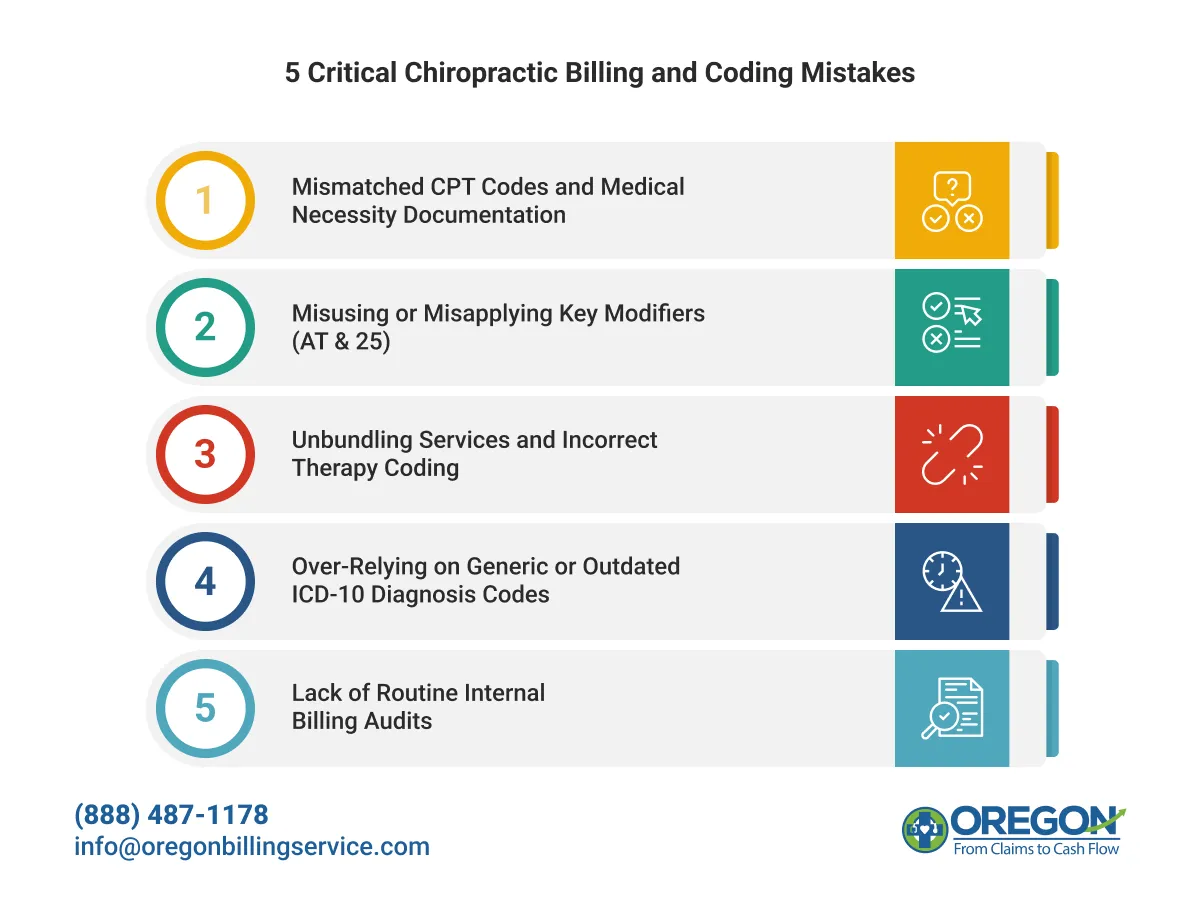
Chiropractors commonly bill spinal manipulation CPT code (98940–98942) without documenting the treatment goals. If your treatment goals don’t align with or fail to show functional improvement, payers issue denial and consider the treatment as maintenance care, not medically necessary.
A permanent fix is to properly document the functional progress the patient has been experiencing and treatment goals are aligning with treatment prognosis. SOAP notes must distinguish between active treatment and maintenance care. Also provide chiropractic billing and coding training to your staff identifying gaps in the claims before submission to minimize such issues.
The second mistake is leaving or omitting the AT modifier on Medicare claims and misuse of modifier -25. Appending the E/M visit modifier with spinal adjustment results in downcoding, rejection or denial due to conflicting details.
Implement a strict rule for CPT coding and modifier use and train your staff to properly follow through the claim. Only add modifier -25 when the E/M visit is for a separate issue and distinct from spinal adjustment. If your team lacks training and skills, outsource offshore chiropractic billing and coding agency.
The third common chiropractic billing mistake revolves around billing passive modalities like mechanical traction (CPT 97012) or electrical stimulation (CPT 97014/G0283) with chiropractic manipulative treatment. When your documentation fails to follow CMS 8-minute rule, payers issue denial.
Chiropractic medical billing and coding services your staff perform must accurately track the treatment or modality time with CPT code. Secondary therapeutic modality must support the primary treatment plan for better clinical outcomes. Avoid unbundling or separate billing for primary and secondary treatment modality if they both are used in conjunction to treat the same condition.
The fourth mistake is over-use of unspecified ICD-10/11 diagnosis codes like M54.50 (unspecified low back pain). Using such codes fails to establish a link between symptoms of disease and its corresponding treatment. Without specificity, payers reject the claims.
Your staff’s chiropractic billing and coding services must be based on the highest level of specificity. Always pair primary subluxation codes (M99.00–M99.05) with neuromuscular conditions or limitations to justify your medical decision making. Doing this reduces clawbacks.
Many chiropractic practices assume that high claim acceptance rates naturally equate to full compliance with payer guidelines. When clinics don’t perform regular or quarterly billing and coding audits, they risk being exposed to insurance clawbacks, charting reviews and panelties if found guilty.
Implement quarter chart reviews of randomly selected 5-10 claims against billed CPT and ICD codes. Find the gaps or discrepancies of your coding and billing practices before insurance does. Ensure full compliance with reimbursement policies of the payers to safeguard your revenue.
In order to make the chiropractic billing and coding process audit-proof, make the different parts of your revenue cycle including documentation, staff’s training and review process work synergically. Here’s a three step action plan that will streamline your revenue cycle:
The first step you should take is to configure your EHR macros and documentation templates directly with payer-specific medical necessity criteria. Taking this step ensures SOAP notes present the true picture of the patient’s condition and medical intervention.
The second step you must take is arranging chiropractic billing and coding classes for your in-house staff. Regular training ensures providers and the RCM staff speak the same language and understand the coding errors, shifts in the payer policies and hidden gaps in the revenue cycle.
Use automated claim scrubbing tools to flag claims with missing modifiers, medical necessity documentation, invalid or outdated ICD and CPT codes to improve first pass rate. Also, submit a claim on payer-specific format and deadline to increase your practice’s compliance with payer defined guidelines.
Avoiding the common medical billing and coding mistakes isn’t about meeting short term goals but protecting your practice’s revenue for the long term. When your team stays updated, trained and ready to take on the changing healthcare landscape, it safeguards your clinic from audits, charting reviews and clawbacks. The mistakes we mentioned above are commonly faced by a majority of chiropractors in the US. Taking the proactive steps to mitigate the damages of these errors and implementing a 3-step action plan ensures your staff is battle-ready to fight with unfair deductions, underpayments and denials.
Is your practice facing AR backlogs and payer audits and you are looking for a reliable and best outsource chiropractic billing and coding company? Contact Oregon Billing Service for a free billing checklist from our experts for a detailed coding audit.