Common ICD-10 Codes for Mental Health Billing: A Practical Guide for Providers
August 28, 2026
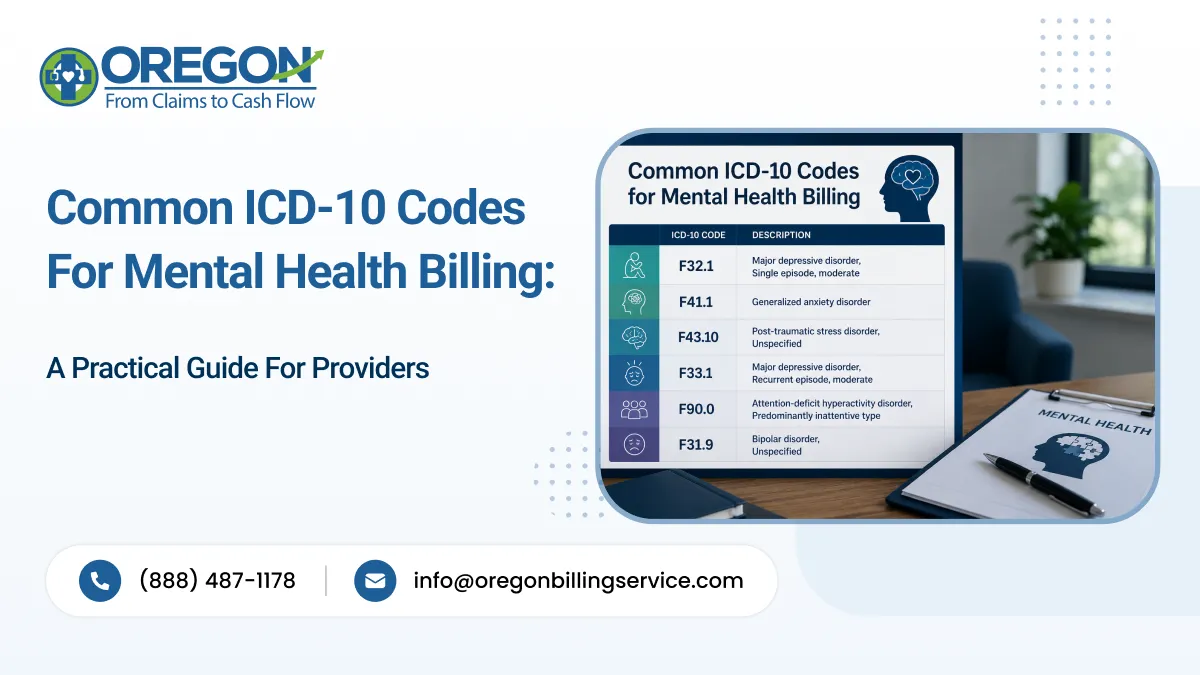
In Mental health billing doing accurate coding is vital. ICD-10-CM codes communicate the patient’s documented diagnosis or reason for the encounter and help connect the clinical record to the services reported on a claim.
Mental health providers commonly use codes from Chapter 5 of ICD-10-CM, which covers mental, behavioral, and neurodevelopmental disorders (F01–F99). Choosing the right code is very difficult, more than identifying a condition. The degree of specificity backed by the clinical record and the provider’s documentation should be reflected in the code.
This guide covers common ICD-10-CM codes used in mental health billing, how to select them, and common coding mistakes that can affect claims.
In the healthcare sectors there are ICD-10-CM codes that providers and coding professionals use to indicate the medical condition of a patient, diagnosis, and the underlying cause of receiving healthcare services.
For example, a psychotherapy claim may include:
The diagnosis reported on the claim should be supported by the provider’s clinical documentation and consistent with the services being billed.
There are some commonly used mental health ICD-10-CM codes that are used in mental health billing. Providers and billing teams should review the codes and payers requirement before submitting the claim and this way they can prevent the chances of claim denials.
Below are some commonly used ICD-10-CM codes,
Depressive disorders are among the most frequently encountered diagnoses in behavioral health.
When a biller starts coding, the core of it depends heavily on the documentation that has been provided by the providers, that includes whether the disorder is single or recurrent , where applicable, severity or remission status.
Anxiety diagnoses cover several conditions, so selecting the appropriate code requires attention to the provider’s documented diagnosis.
For example, F41.1 should not be used simply because a patient reports anxiety. The provider’s documentation should support a diagnosis of generalized anxiety disorder.
Trauma- and stressor-related diagnoses have several code choices based on the documented condition.
| ICD-10-CM Code | Description |
| F43.10 | Post-traumatic stress disorder, unspecified |
| F43.11 | Post-traumatic stress disorder, acute |
| F43.12 | Post-traumatic stress disorder, chronic |
| F43.20 | Adjustment disorder, unspecified |
| F43.21 | Adjustment disorder with depressed mood |
| F43.22 | Adjustment disorder with anxiety |
| F43.23 | Adjustment disorder with mixed anxiety and depressed mood |
| F43.24 | Adjustment disorder with disturbance of conduct |
| F43.25 | Adjustment disorder with mixed disturbance of emotions and conduct |
| F43.81 | Prolonged grief disorder |
These codes should be selected according to the diagnosis documented by the provider rather than based solely on the patient’s symptoms.
Bipolar disorders require attention to the specific diagnosis and, where applicable, the current or most recent episode and remission status.
| ICD-10-CM Code | Description |
| F31.81 | Bipolar II disorder |
| F31.89 | Other bipolar disorder |
| F31.9 | Bipolar disorder, unspecified |
| F32.0–F32.9 | Major depressive disorder, single episode |
| F33.0–F33.9 | Major depressive disorder, recurrent |
| F34.81 | Disruptive mood dysregulation disorder |
| F39 | Unspecified mood [affective] disorder |
The broader F31 and F33 categories contain additional codes that distinguish episode characteristics and remission status. Use the most specific code supported by the documentation.
Common codes in this category include:
| ICD-10-CM Code | Description |
| F42.2 | Mixed obsessional thoughts and acts |
| F42.3 | Hoarding disorder |
| F42.4 | Excoriation (skin-picking) disorder |
| F42.8 | Other obsessive-compulsive disorder |
| F42.9 | Obsessive-compulsive disorder, unspecified |
The diagnosis documented in the clinical record should determine which code is reported.
Mental health practices may also encounter codes for schizophrenia and other psychotic disorders.
| ICD-10-CM Code | Description |
| F20.0 | Paranoid schizophrenia |
| F20.1 | Disorganized schizophrenia |
| F20.2 | Catatonic schizophrenia |
| F20.9 | Schizophrenia, unspecified |
| F21 | Schizotypal disorder |
| F22 | Delusional disorders |
| F23 | Brief psychotic disorder |
| F25.9 | Schizoaffective disorder, unspecified |
These diagnoses can have significant specificity requirements, making documentation particularly important when selecting the final code.
Mental health and behavioral health providers may also report neurodevelopmental diagnoses.
| ICD-10-CM Code | Description |
| F90.0 | Attention-deficit hyperactivity disorder, predominantly inattentive type |
| F90.1 | Attention-deficit hyperactivity disorder, predominantly hyperactive type |
| F90.2 | Attention-deficit hyperactivity disorder, combined type |
| F90.8 | Attention-deficit hyperactivity disorder, other type |
| F90.9 | Attention-deficit hyperactivity disorder, unspecified type |
| F84.0 | Autistic disorder |
| F84.9 | Pervasive developmental disorder, unspecified |
The appropriate ADHD code depends on the type documented by the provider.
Behavioral health practices that treat eating disorders may encounter codes such as:
More specific codes may apply depending on severity, type, or remission status.
Having a list of common codes is useful, but choosing the correct code requires reviewing the clinical documentation.
Before using a diagnosis code a provider or a biller should always review the documented condition that has been provided by the provider. That has the mentioned diagnosis, symptoms and is truly representing the clinical documentation.
When documentation supports greater specificity, use the corresponding code rather than an unspecified option.
For example, documentation that clearly supports generalized anxiety disorder would generally point to F41.1, rather than the broader F41.9.
The diagnosis reported on the claim should be consistent with the provider’s assessment and supporting documentation.
Inconsistent documentation can create questions during claim review or audits.
ICD-10-CM codes are updated periodically. CMS currently lists FY2026 ICD-10-CM files for encounters through September 30, 2026, while FY2027 files are scheduled for encounters beginning October 1, 2026.
Billing teams should verify codes against the applicable year’s official code set rather than relying on an older reference list.
ICD-10-CM and CPT codes serve different purposes on a mental health claim. ICD-10-CM codes identify the diagnosis or reason for care.
CPT codes identify the service performed.
For example, a provider may report an ICD-10-CM code for a patient’s documented depressive disorder along with a CPT code describing the psychotherapy service performed during the encounter.
Using the correct diagnosis does not replace accurate CPT coding. Both sides of the claim need to be supported by the documentation.
Coding problems can contribute to claim denials, payment delays, and additional administrative work.
Common issues include:
There are some specific rules for certain conditions in the mental health coding. For example, the FY2026 ICD-10-CM guidelines contain specific instructions for substance-use diagnoses, that includes how to handle documentation of use, abuse, dependence, and remission.
Accurate diagnosis coding helps create consistency between the patient’s clinical record and the claim.
It can help billing teams:
However, a correct ICD-10 code alone does not guarantee payment. Payer policies, documentation, eligibility, authorization requirements, CPT coding, modifiers, and other claim requirements may also affect reimbursement.
ICD-10 coding is a key part of mental health billing, but the goal is not simply to memorize a list of diagnosis codes. The right code should accurately represent the provider’s documented diagnosis and use the highest level of specificity supported by the record.
Common codes for depression, anxiety, PTSD, adjustment disorders, bipolar disorder, OCD, schizophrenia, ADHD, and other behavioral health conditions can provide a useful starting point. Still, providers and billing teams should verify each code against the applicable ICD-10-CM code set and payer requirements before submitting claims.
Accurate coding, supported documentation, and consistent billing practices can help mental health practices reduce avoidable claim problems and maintain a more efficient revenue cycle.
Accurate coding is only one piece of a healthy revenue cycle. Our medical billing team can help with
ICD-10 coding, claims, denials, and payer requirements
to keep your billing accurate and organized.
What is the most common ICD-10 code used for mental health billing?
There is no single ICD-10 code that applies to all mental health billing. Commonly encountered codes include F41.1 for generalized anxiety disorder, F41.9 for anxiety disorder unspecified, F32.9 for major depressive disorder, single episode, unspecified, and F33.9 for major depressive disorder, recurrent, unspecified. The correct code depends on the provider’s documented diagnosis.
What ICD-10 code is used for anxiety?
Common anxiety-related codes include F41.0 for panic disorder, F41.1 for generalized anxiety disorder, and F41.9 for anxiety disorder, unspecified. Providers should select the code that matches the documented diagnosis.
What ICD-10 codes are used for depression?
Examples include F32.0–F32.9 for major depressive disorder, single episode, and F33.0–F33.9 for recurrent major depressive disorder. More specific codes distinguish factors such as severity and remission status.
Can mental health providers use unspecified ICD-10 codes?
Yes, when the diagnosis is genuinely documented as unspecified or the available documentation does not support a more specific code. However, providers should not choose an unspecified code when the record supports a more specific diagnosis.
How often are mental health ICD-10 codes updated?
ICD-10-CM is updated annually, with the new code set generally taking effect October 1. CMS provides the official code files and guidelines for each fiscal year.
Does the ICD-10 code determine how much a mental health provider gets paid?
Not by itself. ICD-10 codes identify the diagnosis, while reimbursement can depend on factors including the CPT code, payer policy, documentation, medical necessity, patient eligibility, authorization, and the provider’s contract with the payer.