Eligibility Verification Process: A Complete Guide for Providers
September 1, 2026
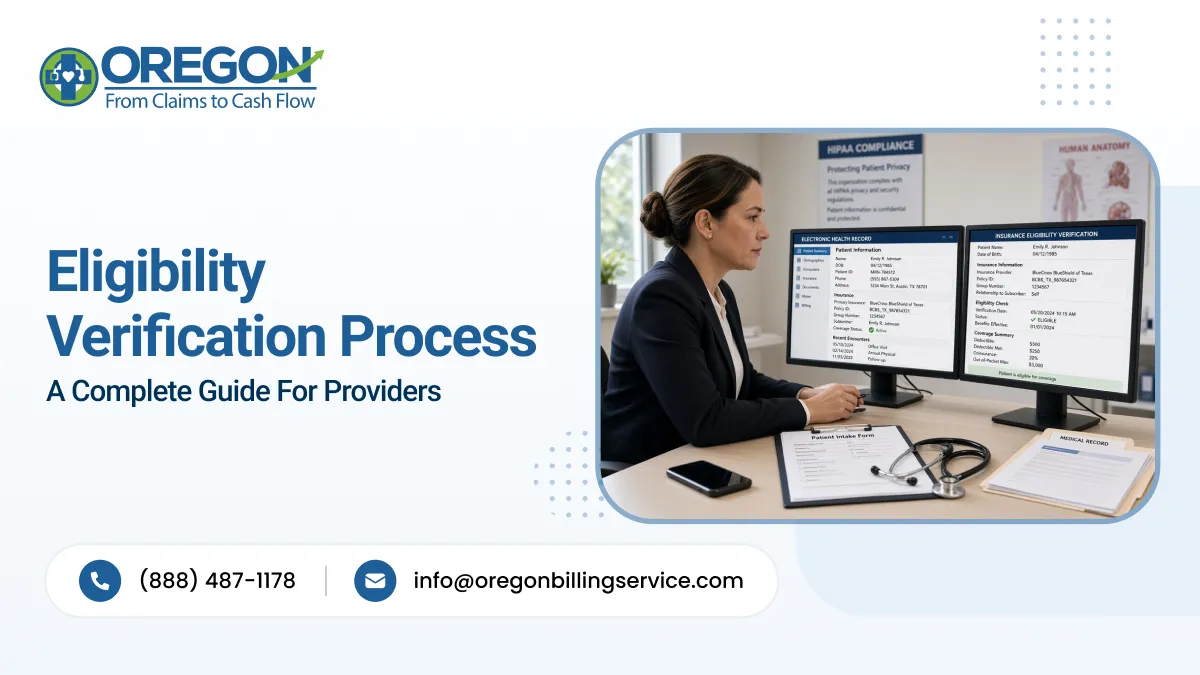
A patient may have an active insurance plan, but that does not automatically mean every service your practice provides will be covered.
Therefore, the eligibility verification process is a critical phase in the revenue cycle. Prior to the appointment/procedure, the practice must verify the patient’s coverage is current and capture benefit details, cost sharing and other information related to the scheduled service.
A proper verification process can help providers identify coverage issues before a claim is submitted, reduce avoidable billing problems, and give patients a clearer idea of their financial responsibility.
The HIPAA-standard 270/271 transaction allows healthcare providers to seek eligibility and benefit information from a health plan for electronic eligibility enquiries and obtain a response. CMS says qualifying answers could include things like deductibles, copayments, coinsurance, and coverage for certain types of services.
This tutorial walks you through the eligibility verification process, what billing teams should be on the lookout for, typical pitfalls, and best practices to develop a dependable workflow.
The eligibility verification process is the process of confirming a patient’s health insurance coverage and benefits before healthcare services are provided.
It goes beyond simply asking, “Does the patient have insurance?”
A thorough verification may involve checking:
The exact information available depends on the payer, plan, service, and eligibility response.
Eligibility verification connects front-end patient registration with the rest of the revenue cycle.
When insurance information is incorrect or coverage is inactive, the problem can appear later as a denied or rejected claim. By identifying issues before the appointment, staff have an opportunity to correct the information or communicate with the patient.
A patient may have provided an insurance card months ago, but coverage can change because of:
Verifying eligibility before the encounter helps the practice work with current information.
Eligibility responses may provide information about deductibles, copayments, and coinsurance. CMS’s eligibility operating rules specifically address the availability of financial information through eligibility transactions.
This can help staff communicate expected patient responsibility more accurately.
Correct payer information is essential for claim submission.
Claims may need to be corrected or further followed up if the practice invoices the wrong payer, utilizes outdated member information or ignores coordination-of-benefits information.
Unexpected medical bills can create frustration for patients.
A consistent verification process gives staff an opportunity to explain coverage and potential financial responsibility before services are provided.
Eligibility verification is a front-end RCM activity.
Errors caught before the encounter are generally easier to address than problems discovered after a claim has already been submitted.
A complete insurance verification should be tailored to the patient’s planned service.
At minimum, staff should review the patient’s insurance and determine whether the information returned by the payer supports the upcoming encounter.
Verify information such as:
Even a small demographic mismatch can create problems during claim processing.
Determine whether the patient’s coverage is:
An active policy does not necessarily mean the specific service is covered.
This is one of the most important parts of verification.
For example, a practice should not stop after confirming that a patient has active coverage. The team should determine, when available, whether the planned service type has applicable benefits and restrictions.
Depending on the payer and response, verification may provide information about:
These amounts should be treated as eligibility information rather than an absolute guarantee of payment.
Determine whether the provider or facility is participating with the patient’s plan when network status is relevant.
A patient’s financial responsibility can differ significantly depending on whether the provider is in-network or out-of-network.
Eligibility verification and authorization verification are related, but they are not the same thing.
A patient may be eligible for a health plan while a particular service still requires authorization or a referral.
The practice should therefore verify applicable requirements separately rather than assuming that active eligibility means automatic coverage.
A reliable workflow typically follows several steps.
START
PAYER
INQUIRY
CHECK
MATCH
RECORD
ACTION
Start with accurate registration information.
Obtain the patient’s:
The more accurate the information entered into the system, the more useful the eligibility response will be.
Determine which insurance company or health plan should be contacted.
This becomes particularly important when a patient has:
The practice should establish which payer is responsible for the planned service based on the patient’s circumstances and applicable coordination-of-benefits rules.
The practice can use a payer portal, clearinghouse, practice management system, or another authorized eligibility solution.
For electronic transactions, the standard eligibility inquiry is the X12 270, and the corresponding response is the X12 271.
CMS explains that the 270/271 transaction is the HIPAA-adopted standard for health plan eligibility and benefit inquiries and responses.
Receiving a response is not the end of the process.
Staff should actually review the information returned.
Look for:
The next question should be:
Does the patient’s coverage information support the service scheduled for this encounter?
For example, confirming active coverage alone may not answer whether a particular procedure, therapy, diagnostic service, or specialty visit has applicable benefits.
Record the verification in the practice management system or appropriate workflow.
Useful documentation may include:
If the response shows inactive coverage, incorrect information, or another issue, address it before services are provided whenever possible.
This may involve:
The 270/271 transaction is a standardized electronic method for exchanging health plan eligibility and benefit information.
Think of it as a question-and-answer process:
270 = Provider’s eligibility inquiry
271 = Payer’s eligibility response
CMS describes the 270 as the eligibility/benefit inquiry and the 271 as the corresponding response.
A provider is scheduling a procedure for a patient.
The billing system sends a 270 eligibility request containing the necessary patient and payer information.
The payer returns a 271 response.
The billing team reviews the response to determine available eligibility and benefit information.
The team can then use that information to support registration, patient communication, and claim preparation.
A 271 response can contain valuable information about a patient’s coverage and financial responsibility.
Depending on the payer and transaction, information may include:
| Information | Why it matters |
| Eligibility status | Determines whether coverage is reported as active |
| Effective dates | Helps identify the applicable coverage period |
| Deductible | Helps estimate patient responsibility |
| Copay | Indicates applicable fixed cost-sharing |
| Coinsurance | Helps estimate percentage-based responsibility |
| Service-type benefits | Helps determine applicable benefit information |
| Network information | May affect patient cost-sharing |
| Other coverage information | May help identify coordination-of-benefits issues |
For Medicare specifically, CMS’s HETS 270/271 system provides eligibility data that can be used to prepare accurate Medicare claims, determine beneficiary liability, and check eligibility for specific services.
However, the response should not be treated as an absolute guarantee that a claim will be paid.
Coverage information and actual claim adjudication are separate processes.
These terms are often used interchangeably, but there is a useful distinction.
Eligibility verification generally focuses on whether the patient’s insurance coverage is active and what benefit information is available.
Insurance verification can be broader and may include reviewing eligibility, benefits, network status, authorization requirements, referrals, deductibles, and expected patient responsibility.
In practice, many medical billing teams use the terms interchangeably. What matters most is having a workflow that checks the information necessary for the specific encounter.
There is no single workflow that fits every specialty or payer.
However, many practices verify eligibility:
For recurring patients, verification may need to occur periodically rather than only once.
Insurance information can change between visits.
Same-day verification can be useful for urgent, walk-in, or unscheduled services.
However, practices should not rely exclusively on same-day checks if their workflow allows earlier verification.
Earlier verification provides more time to correct problems before the patient arrives.
Even practices with an established workflow can encounter verification problems.
Patients sometimes keep an outdated insurance card in their wallet.
Always compare the insurance information in the system with the most recent information available.
Submitting an eligibility inquiry to the wrong payer can produce a response that does not accurately reflect the coverage applicable to the encounter.
An active policy does not automatically mean the scheduled service is covered.
Staff should review benefit information relevant to the planned service whenever available.
A plan may be active now but not active on the date of service—or coverage may begin after the scheduled appointment.
Date-specific verification matters.
If deductible, copay, or coinsurance information is available but not reviewed, the practice may miss an opportunity to communicate expected costs.
This is a critical mistake.
Eligibility verification provides information about reported coverage and benefits. Final payment depends on claim adjudication and applicable payer rules.
If the practice does not record what was verified and when, staff may have difficulty determining what information was available before the encounter.
A strong process is not simply about checking insurance more often. It is about making the workflow consistent.
Use a checklist that covers:
The checklist can be adjusted by specialty.
Whenever practical, verify coverage before the scheduled date.
This provides time to resolve problems instead of discovering them at registration.
Electronic eligibility tools can reduce repetitive manual work.
CMS recognizes electronic eligibility transactions as a standardized way to obtain eligibility and benefit information.
Automation can be particularly useful for practices with high patient volumes.
Record the verification result in the practice management or billing system.
This creates an internal record that can help staff during claim follow-up.
Don’t treat an eligibility response as authorization confirmation.
A patient can have active coverage and still require prior authorization for a particular service.
Eligibility verification should not be treated as a task that only the billing department understands.
Registration staff, scheduling teams, authorization staff, and billing personnel may all interact with insurance information.
Consistent training can help prevent information from being lost between departments.
Medicare eligibility verification follows the same basic principle: the provider needs current information about the beneficiary’s Medicare coverage and applicable financial responsibility.
CMS’s HIPAA Eligibility Transaction System (HETS) allows Medicare providers, suppliers, and authorized billing agents to check Medicare beneficiary eligibility information in real time. The system supports HIPAA-compliant 270 requests and 271 responses.
CMS says HETS can be used to:
There is an important 2026 consideration for practices using Medicare HETS.
CMS states that, beginning May 11, 2026, HETS requires a valid HETS EDI enrollment on file for every NPI submitted in an eligibility request.
Providers using vendors or clearinghouses should therefore confirm that their HETS EDI enrollment arrangements are current.
CMS’s current HETS documentation also indicates that HETS supports real-time 270/271 transactions rather than batch transactions.
Eligibility verification happens before the claim, but its effects can continue throughout the revenue cycle.
A simplified workflow looks like this:
Patient Registration → Eligibility Verification → Benefits Review → Authorization/Referral Check → Service → Coding → Claim Submission → Adjudication → Payment
When the front end is accurate, downstream billing teams have better information to work with.
When eligibility is skipped or performed incorrectly, problems may appear later as:
That is why eligibility verification should be viewed as part of revenue cycle management, not simply an administrative registration task.
Consider a patient scheduled for a specialty procedure.
The patient has an insurance card on file, so the appointment is initially scheduled.
During eligibility verification, the billing team discovers:
The eligibility check did not complete the entire billing process. Instead, it identified the next step.
The authorization team can now address the requirement before the procedure rather than waiting for the claim to be denied.
This illustrates an important point:
Eligibility verification is a decision-support step—not a guarantee of reimbursement.
For a more reliable process, providers should consider these practices:
What is the eligibility verification process in medical billing?
The eligibility verification process involves checking a patient’s insurance coverage and benefits before healthcare services are provided. It may include verifying active coverage, effective dates, deductibles, copays, coinsurance, network status, and service-specific benefit information.
Why is eligibility verification important?
Eligibility verification helps providers identify insurance and coverage issues before services are billed. It can support cleaner claims, more accurate patient responsibility estimates, and fewer avoidable billing problems.
What is a 270 eligibility transaction?
The X12 270 is an electronic health plan eligibility and benefit inquiry sent by a provider or authorized entity to a health plan. The payer responds with a 271 eligibility and benefit response. CMS recognizes the 270/271 as the HIPAA-adopted standard for these transactions.
What is a 271 eligibility response?
A 271 is the electronic response to a 270 eligibility inquiry. It can provide information about eligibility, coverage, and financial responsibility, depending on the payer and information available.
Does eligibility verification guarantee claim payment?
No. Eligibility verification does not guarantee that a claim will be paid. The final payment decision depends on claim adjudication, applicable coverage rules, documentation, coding, medical necessity, authorization requirements, and other payer policies.
How often should insurance eligibility be verified?
The appropriate frequency depends on the practice, payer, specialty, and patient circumstances. Practices commonly verify before scheduled services and reverify when insurance information changes or when there is a reason to question existing coverage.
What is the difference between eligibility verification and prior authorization?
Eligibility verification determines whether a patient has reported coverage and provides available benefit information. Prior authorization is a separate payer requirement that may require approval before a specific service is performed.
Can eligibility verification reduce claim denials?
It can help prevent some eligibility-related problems by identifying inactive coverage, incorrect payer information, and other issues before claim submission. It cannot prevent every type of denial because many denials result from coding, documentation, authorization, medical necessity, or other issues.
The eligibility verification process is one of the most important front-end steps in medical billing.
A patient’s insurance card alone does not tell the whole story. Practices need to confirm current eligibility, review relevant benefits, identify patient responsibility, and recognize requirements such as referrals or prior authorization.
Electronic 270/271 transactions can make this process more efficient, while a consistent internal workflow helps staff act on the information they receive.
The goal is simple: verify the right information before the service, document what was verified, and address coverage problems before they become billing problems.
Oregon Billing Service helps healthcare practices streamline eligibility and benefits verification, confirm coverage details, identify potential issues before claims are submitted, and keep front-end billing workflows organized.
Spend less time chasing coverage information.