Endoscopic Sleeve Gastroplasty (ESG) ICD-10 Codes: Complete Coding and Billing Guide
November 9, 2026
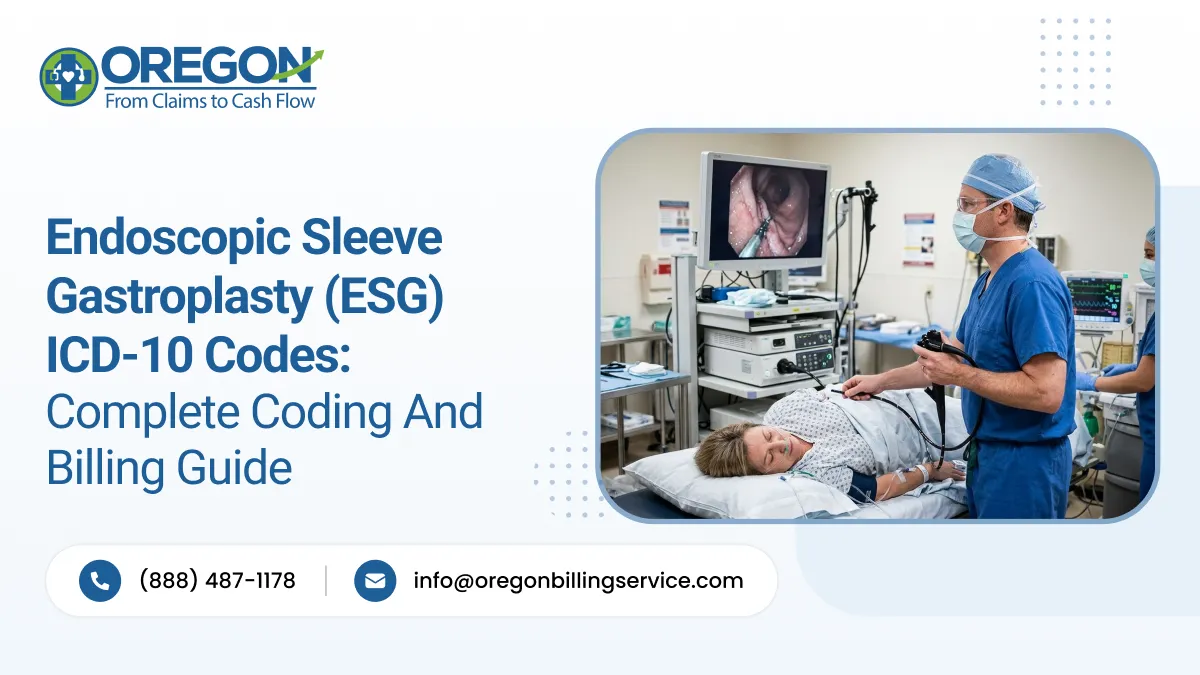
Endoscopic Sleeve Gastroplasty (ESG) ICD-10 coding requires an accurate obesity diagnosis, proper documentation, and the correct procedure code. While ESG has no single ICD-10-CM diagnosis code, providers commonly use codes from category In connection with E66 as well as the relevant BMI codes. CPT 43889 being currently available for ESG, medical facilities have to be aware of the current reimbursement guidelines and claim mistakes.
Endoscopic Sleeve Gastroplasty (ESG) is a minimally invasive method of losing weight that involves reducing the stomach’s volume using endoscopic suturing. The procedure does not involve any removal of the stomach tissues as in case of sleeve gastrectomy.
In the procedure, a specially trained provider inserts an endoscope into the body via the mouth using which he reshapes the stomach by using the suture device.
ESG can be a choice for some patients with obesity who need further medical assistance besides lifestyle changes.
While no external incisions may be involved in this procedure, there are numerous things to consider with regard to the selection, documentation, and management of the procedure.
There is no designated ICD-10-CM code for Endoscopic Sleeve Gastroplasty.
Instead, the appropriate ICD-10-CM code will depend on the obesity diagnosis that the patient has, or any other diagnosis for that matter.
The below are some of the possible obesity diagnosis codes that can be used in an ESG encounter.
Code descriptions and documentation considerations
| ICD-10-CM Code | Description | Coding Consideration |
|---|---|---|
| E66.811 | Obesity, class 1 | Provider documents class 1 obesity |
| E66.812 | Obesity, class 2 | Provider documents class 2 obesity |
| E66.813 | Obesity, class 3 | Provider documents class 3 obesity |
| E66.01 | Morbid (severe) obesity due to excess calories | Documentation supports the diagnosis |
| E66.2 | Morbid (severe) obesity with alveolar hypoventilation | Provider documents the associated condition |
| E66.9 | Obesity, unspecified | Obesity is documented without sufficient specificity |
| E66.3 | Overweight | Documented overweight, not interchangeable with obesity |
These codes characterize the condition of the patient and not the ESG procedure itself.
For instance, if the physician notes class 2 obesity in the patient’s medical record, E66.812 might be used. Nevertheless, the office needs to evaluate BMI, comorbidities, and coding rules for that patient.
Important: E66.01 should not be applied automatically when a patient undergoes a procedure related to obesity. The code assignment should be done based on the medical record documentation.
In FY 2027 ICD-10-CM Guidelines, there is stress on the accurate documentation of the obesity severity.
These obesity class codes introduced in October 2024 help in identifying three categories of adult obesity.
| Obesity Class | ICD-10-CM Code | Adult BMI Range |
|---|---|---|
| Class 1 obesity | E66.811 | 30.0–34.9 |
| Class 2 obesity | E66.812 | 35.0–39.9 |
| Class 3 obesity | E66.813 | 40.0 or higher |
These classifications help medical coding teams represent the severity of a documented obesity diagnosis.
However, the BMI value alone does not establish the diagnosis code.
No. There is a need for the provider to indicate the obesity class first before the coder codes either E66.811, E66.812 or E66.813.
For instance, take a case where the BMI of a patient is 37.5. The coding for the same should not be done with E66.812 code because although the figure suggests class 2 obesity, coders are supposed to wait for provider documentation.
Coding staff should ask for any clarifications if necessary.
Moreover, under the FY 2027 coding guidelines, when the provider codes class 3 obesity and morbid obesity, the coders have to use only the code for class 3 obesity, but not both.
For complete instructions, review the CMS FY 2027 ICD-10-CM Official Coding Guidelines.
The BMI codes supply more details on the body mass index of the patient.
As far as health care facilities, they apply the Z68 category codes in combination with obesity diagnosis if possible under the circumstances.
| ICD-10-CM Code | BMI Range |
| Z68.30 | BMI 30.0–30.9 |
| Z68.31 | BMI 31.0–31.9 |
| Z68.32 | BMI 32.0–32.9 |
| Z68.33 | BMI 33.0–33.9 |
| Z68.34 | BMI 34.0–34.9 |
| Z68.35 | BMI 35.0–35.9 |
| Z68.36 | BMI 36.0–36.9 |
| Z68.37 | BMI 37.0–37.9 |
| Z68.38 | BMI 38.0–38.9 |
| Z68.39 | BMI 39.0–39.9 |
| Z68.41 | BMI 40.0–44.9 |
| Z68.42 | BMI 45.0–49.9 |
| Z68.43 | BMI 50.0–59.9 |
| Z68.44 | BMI 60.0–69.9 |
| Z68.45 | BMI 70 or greater |
A code for BMI may be beneficial, but it doesn’t mean that the patient qualifies for ESG based on the insurer’s eligibility requirements.
CPT 43889 is the exact code used for Transoral Endoscopic Sleeve Gastroplasty as of January 1, 2026.
Prior to this change, most professional coding personnel were coding ESG as CPT 43999, which is the unlisted stomach procedure code.
The adoption of CPT 43889 gave the procedure a standardized Category I code.
As per the American Gastroenterological Association, CPT code 43889 includes transoral ESG, including argon plasma coagulation wherever applicable.
| Code | Procedure | Billing Relevance |
| 43889 | Transoral endoscopic sleeve gastroplasty | Specific CPT code effective January 1, 2026 |
| 43999 | Unlisted procedure, stomach | Historical professional ESG reporting approach |
| C9784 | Endoscopic sleeve gastroplasty | Historical hospital outpatient ESG reporting |
| 43775 | Laparoscopic sleeve gastrectomy | Separate surgical procedure; not for ESG |
This is an important difference, as ESG and laparoscopic sleeve gastrectomy use different methods. CPT 43775 must never be used in place of CPT 43889 simply due to the reduction in the size of the stomach.
When performed by the provider as part of the ESG, CPT code 43889 covers argon plasma coagulation.
Additionally, the gastroenterology societies recommend that the following CPT codes for included endoscopic services should not be reported along with CPT 43889:
Before reporting any additional same session procedures, the billing staff must review all relevant CPT codes and payer edits.
Yes. CPT 43889 has a 90-day global period.
Routine postoperative evaluation and management services related to the procedure generally fall within the global surgical package.
Nevertheless, if there is an E/M encounter unrelated to the post-op care that is separately identifiable, it can be reported separately using the modifier 24 under certain conditions.
For current procedure guidance, review the American Gastroenterological Association’s Bariatric Endoscopy Coding FAQs.
ICD-10-PCS is used for inpatient hospital procedures, while CPT and HCPCS codes are used mostly for outpatient and professional procedures.
The ICD-10-PCS code for inpatient procedure with the restriction of stomach using an endoscopy through the natural or artificial opening is:
0DV68ZZ — Restriction of Stomach, Via Natural or Artificial Opening Endoscopic.
This code describes the procedure’s root operation, body part, and approach.
However, coders must review the operative report and official ICD-10-PCS tables before assigning the code.
It is not true that because the hospital does ESG, it will mean that there will be inpatient ICD-10-PCS reporting. This will depend on whether the patient is an inpatient or an outpatient.
Endoscopic sleeve gastroplasty and surgical sleeve gastrectomy both support weight-loss treatment, but they are different procedures.
| Feature | Endoscopic Sleeve Gastroplasty | Surgical Sleeve Gastrectomy |
| Technique | Endoscopic suturing | Surgical stomach resection |
| External incisions | Typically none | Usually laparoscopic incisions |
| Stomach tissue removed | No | Yes |
| CPT code | 43889 | 43775 for laparoscopic sleeve gastrectomy |
| Procedure documentation | Endoscopy and suturing details | Surgical resection details |
| Insurance coverage | ESG-specific requirements | Separate bariatric surgery requirements |
It is imperative that healthcare practitioners identify the exact procedure performed.
The operative report should reflect the procedure code used as well as differentiate the procedure from other bariatric procedures.
Patients undergoing ESG evaluation may have additional documented medical conditions associated with obesity.
These diagnoses can help describe the patient’s health status and may be relevant to medical necessity reviews.
| Condition | Example ICD-10-CM Code |
| Type 2 diabetes mellitus without complications | E11.9 |
| Essential hypertension | I10 |
| Obstructive sleep apnea | G47.33 |
| Gastroesophageal reflux disease without esophagitis | K21.9 |
| Hyperlipidemia, unspecified | E78.5 |
| Prediabetes | R73.03 |
These situations must only be reported when the medical record and appropriate coding guidelines for encounters allow it.
The existence of a condition associated with obesity is not necessarily enough to qualify the ESGs for coverage.
For instance, the patient may suffer from class 2 obesity and obstructive sleep apnea. But the insurer may require additional documentation.
Coverage for the Endoscopic Sleeve Gastroplasty is determined by the insurer, the type of insurance and the medical necessity. Though, there is the universal coding for the procedure that is offered by CPT 43889, however, it does not imply that the procedure will be covered in any case.
Some insurers cover the procedure by certain criteria, other insurance companies only cover the ESG in investigational studies.
| Payer | What Providers Should Review |
| Aetna | Clinical Policy Bulletin 0157, including ESG exclusions or investigational language |
| Anthem | Applicable bariatric surgery medical policy and plan-specific clinical criteria |
| Cigna | Current bariatric procedure policy and benefit requirements |
| UnitedHealthcare | Applicable commercial or Medicare Advantage bariatric coverage policies |
| Original Medicare | National and applicable local Medicare coverage requirements |
For example, Aetna’s Obesity Surgery Policy includes restrictions affecting endoscopic obesity procedures.
Meanwhile, other insurers have adopted different policy language regarding ESG eligibility.
As a result, healthcare practices should review the current policy for the patient’s specific insurance product instead of relying on generalized coverage statements.
Prior to scheduling the procedure, it would be advisable for the billing department to check if:
The patient’s insurance policy offers benefits on bariatric or obesity management.
Note: Prior authorization is not a guarantee for payment. The insurance company may still evaluate if the patient qualifies under their policy.
Proper documentation plays a central role in ESG coding and reimbursement.
The medical report needs to state the diagnosis, rationale for treatment, and the procedure.
Confirmed obesity diagnosis
The provider should document the patient’s obesity diagnosis and class when clinically established.
BMI and weight history
The record should include relevant BMI measurements, weight history, and other information required by the applicable policy.
Previous weight-management treatment
When relevant, document the patient’s previous weight-management interventions and clinical response.
Associated medical conditions
Note any known conditions that would impact treatment decisions or fall under encounter reporting criteria, for example, diabetes, hypertension, or obstructive sleep apnea.
Treatment rationale
The clinical record should explain why the provider recommends ESG for the individual patient.
Operative report
The report is expected to cover the endoscopic technique, suturing, findings, other procedures and possible complications.
Authorization documentation
In case of need for authorization, keep the information about the authorization and related correspondence.
Follow-up treatment plan
Documentation of post-surgery care, nutrition, and follow-up process will be included when required.
It is needed to make sure that the code billed is accurate based on the services performed and the medical information available.
Several coding and administrative mistakes can create unnecessary claim delays.
Choosing an obesity class without any documentation from the provider may cause discrepancies in the code assignment and the patient’s record.
How to avoid it: Check the physician’s note for additional information.
Older billing resources may still recommend CPT 43999 for ESG.
However, CPT 43889 became effective January 1, 2026.
How to avoid it: Keep coding references, charge templates, and billing software updated for the applicable date of service.
CPT 43775 is for Laparoscopic Sleeve Gastrectomy, not Transoral ESG.
How to avoid it: Cross-check procedure coding against operative report instead of using similar procedure titles.
Some policies need prior authorization of the service.
The absence of an authorization might result in denial due to prior authorization requirement.
How to avoid it: Verify whether the prior authorization is required beforehand.
CPT 43889 contains some endoscopy services and argon plasma coagulation when done.
How to avoid it: Look at CPT guidelines and bundling rules prior to billing other services
Routine postoperative E/M care related to ESG generally falls within its 90-day global period.
How to avoid it: Distinguish routine postoperative care from separately reportable unrelated services and apply modifiers only when supported.
Not every insurer covers ESG, even when the provider uses the correct CPT and ICD-10 codes.
How to avoid it: Make sure the procedure is covered by your plan, and that it meets medical necessity criteria.
The following examples illustrate how coding decisions depend on clinical documentation.
A provider documents class 1 obesity in a patient with BMI 33.5 and performs outpatient ESG.
| Coding Element | Code |
| Obesity diagnosis | E66.811 |
| BMI | Z68.33 |
| ESG procedure | CPT 43889 |
The practice must confirm the patient’s coverage and document medical necessity according to the applicable policy.
A patient has provider-documented class 2 obesity, BMI 37.2, and type 2 diabetes without documented complications.
The provider performs ESG after completing the required clinical evaluation.
| Coding Element | Code |
| Obesity diagnosis | E66.812 |
| BMI | Z68.37 |
| Additional diagnosis, when reportable | E11.9 |
| ESG procedure | CPT 43889 |
The coding team should confirm that the record supports each diagnosis and follow applicable diagnosis sequencing rules.
A provider documents class 3 obesity and BMI 42.8 before performing ESG.
| Coding Element | Code |
| Obesity diagnosis | E66.813 |
| BMI | Z68.41 |
| ESG procedure | CPT 43889 |
If the medical record also describes morbid obesity, the practice should follow the FY 2027 instructions for class 3 obesity rather than automatically reporting both codes.
These examples illustrate code selection only. They do not establish coverage or guarantee reimbursement.
A standardized billing process can assist gastroenterologists and bariatric physicians to detect any issues with the documentation and reimbursement before filing the claim.
Check for the existence of active health insurance, benefits of the plan, eligibility of the provider, and bariatric limitations.
Check for medical necessity and if the documentation justifies the procedure.
Authorization must be obtained and the information should be kept in the billing record of the patient.
Match the documented obesity diagnosis to the correct ICD-10-CM code and report CPT 43889 when appropriate for the completed procedure.
Check the rendering provider, place of service, authorization information, coding, modifiers, and other claim requirements.
Monitor payer responses and identify rejections, denials, or requests for additional documentation.
Review remittance information, determine the reason for payment discrepancies, and follow the appropriate correction or appeal process.
This approach helps healthcare practices maintain organized billing records and respond to claim issues more efficiently.
Clinical research provides useful context for ESG’s role in obesity treatment.
The randomized MERIT trial, published in The Lancet in 2022, evaluated ESG combined with lifestyle modification against lifestyle modification alone.
At 52 weeks, researchers reported:
The study also reported serious ESG-related adverse events in approximately 2% of the treated safety population.
These findings demonstrate the procedure’s potential benefits among the patients studied, but individual outcomes vary.
Providers can review the MERIT randomized clinical trial for additional details.
Despite evidence supporting ESG, insurers make coverage decisions using their own medical policies and benefit criteria.
What is the ICD-10 code for ESG?
The condition does not have a unique ICD-10-CM code for ESG. Physicians often use the correct obesity codes, which include E66.811, E66.812, or E66.813 if there is documentation.
What is the CPT code for Endoscopic Sleeve Gastroplasty in 2027?
CPT code 43889 will be used for the transoral procedure starting January 1, 2026. Billing staff needs to understand the CPT guidelines and payers’ needs for the particular service date.
Is ESG the same as surgical sleeve gastrectomy?
No. The endoscopic procedure creates an artificial narrowing with a needle suturing technique while surgery removes part of the stomach.
Does Medicare cover Endoscopic Sleeve Gastroplasty?
Original Medicare does not establish blanket national ESG coverage under its bariatric surgery National Coverage Determination. Providers should verify applicable Medicare coverage requirements for the individual service.
Can BMI alone determine an ESG obesity diagnosis code?
No. Although BMI values help describe obesity severity, providers must document the obesity class to support the corresponding class-specific ICD-10-CM code.
Why do insurers deny ESG claims?
These denials may be based on excluded benefits, lack of prior authorization, insufficient documentation, wrong procedure codes, unsupportable diagnosis, and various payer-specific conditions. It is important to analyze the reasons for the denial prior to rectification or appeal of the claim.
ICD-10 coding of Endoscopic Sleeve Gastroplasty needs documentation of obesity, proper choice of diagnosis, and accurate coding of procedure performed. In the light of availability of CPT 43889 for ESG and obesity coding rules for FY 2027 focusing on specificity, it is essential to be up-to-date with regard to coding procedures.
The process of insurance verification, medical necessity documentation, and proper claims review are other important aspects that need to be fulfilled to avoid any preventable problems during the coding and submission processes.
The use of wrong obesity ICD-10 codes, incorrect CPT 43889 reporting, insufficient documentation, and limitations on insurance coverage may lead to unnecessary delays and claim denials.
Specialized billing assistance for your medical office may help to check the ESG coding accuracy, ensure insurance requirements, check claim denials, and improve workflow processes.
From accurate obesity diagnosis coding and CPT 43889 reporting to insurance verification and denial follow-up, Oregon Billing Service can help your practice manage the billing details behind ESG procedures.