Enlarged Lymph Nodes ICD 10: A Provider’s Guide to Coding
October 16, 2026
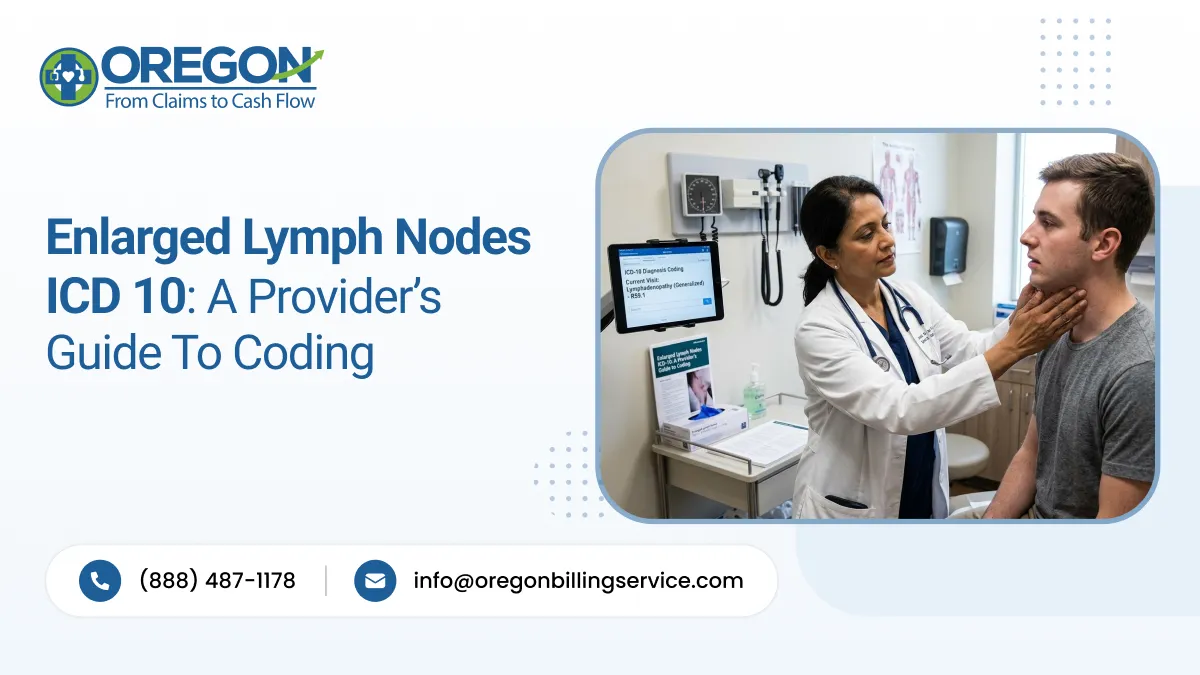
A swollen lymph node in the neck is presented by a patient. Upon examining the patient, you confirm swelling of the lymph nodes, but the etiology has yet to be pinpointed. Is it appropriate for you to diagnose either local lymphadenopathy, unspecified finding, or the suspected disease?
The choice depends on what you diagnose through your clinical assessment.
The enlarged lymph nodes ICD 10 codes belong to category R59, with three billable options: R59.0, R59.1, and R59.9. Selecting the right one calls for detailed documentation of the location of the lymph nodes and diagnosis made at the point of encounter.
The problem for providers not simply determining the code. This will entail ensuring that the medical history of the patient corroborates with the diagnoses provided in the claim form. The diagnosis in the claim form is quite ambiguous in that it may be localized, generalized or neither.
The below reference explains how to select the correct ICD-10-CM code for FY2027, describing the findings in the cervix and axilla areas, and avoiding any coding errors.
The ICD-10-CM coding system gives three codes for enlarged lymph nodes. The codes are distinct depending on the appearance of the symptoms; therefore, selection is determined by the assessment.
The following codes apply to FY2027, effective October 1, 2026, through September 30, 2027.
| ICD-10-CM Code | Official Description | When to Use It |
|---|---|---|
| R59.0 | Localized enlarged lymph nodes | When enlargement is observed in a specific anatomical area, such as the neck, axillary, or inguinal regions. |
| R59.1 | Generalized enlarged lymph nodes | When the assessment establishes generalized enlargement. This code also includes lymphadenopathy NOS. |
| R59.9 | Enlarged lymph nodes, unspecified | When enlarged nodes are documented without enough detail to establish their distribution, subject to Index instructions. |
Although all three codes describe lymph node enlargement, they are not interchangeable.
For example, a patient with two enlarged cervical nodes may still have localized lymphadenopathy. The number of palpable nodes alone does not establish generalized enlargement.
There is also an important terminology distinction. Lymphadenopathy NOS is found in ICD-10-CM under code R59.1, but the enlarged lymph nodes unspecified is covered under R59.9. For the healthcare professionals, it is important that they review whether the wording in the documentation corresponds to the Alphabetic Index and Tabular List.
Category R59 itself is not billable. A complete code must be selected.
The coding issue in question is straightforward. What was found on examination, and how well is the finding described in the assessment?
A properly documented patient visit allows the coders to answer three questions without having to interpret the findings on their own.
The distribution of the disease becomes the most important point for the code assignment.
In case the examination finds enlargement restricted to the cervical area, R59.0 can be used. In case the healthcare provider confirms the presence of lymphadenopathy affecting different anatomical sites, R59.1 is applicable.
Consider these two assessments:
The first assessment supports consideration of R59.0. The second may support R59.1.
If the clinician has established the distribution, it should appear clearly in the medical record. Coders should not have to infer generalized involvement from scattered examination findings.
There are many causes of enlarged lymph nodes, including infection, inflammation, malignancy, and others. Nevertheless, enlargement alone will not provide a diagnosis of any of the above.
If there is swelling of cervical lymph nodes after a patient suffers from a respiratory infection, you may use R59.0 if the cause is not confirmed.
The respiratory infection is clinical history but does not mean that the cause of the lymph nodes is an infection necessarily.
In case there is evidence of an underlying condition, use the respective code for the disease and follow the guidelines of reporting.
An unspecified code is not automatically incorrect. It may be appropriate when the available clinical documentation does not establish the distribution of enlargement.
As an example, a note that states “enlarged lymph nodes” can be used to look into coding for R59.9 following evaluation of the index.
Unspecified codes cannot be used to replace any data that is known to you as a result of your examination.
If there is a localized finding, its documentation in the assessment will help to choose the correct code.
Enlarged cervical lymph nodes are common presentations in primary care, pediatric, and ENT cases. They can be noted by providers while examining the patient’s swollen neck, throat conditions, or other complaints.
Where there is a provider diagnosis of localized cervical lymphadenopathy, the code for enlarged lymph nodes of the neck is R59.0 in ICD-10-CM.
It really makes no difference if it is the right or left side since lateralization is still clinically significant information.
Specify the particular cervical level affected when clinically indicated, whether unilateral or bilateral enlargement, along with any findings from the exam that affect your clinical impression.
These include:
These details should reflect the patient’s presentation. There is no need to add extensive examination language simply to support an R59 code.
Clinical example
The patient is taken to the hospital with an enlarged neck, without any pain. It was noted that the patient had enlarged and movable lymph nodes on the neck region, especially on the left side with the size of 1.5cm. There is no infection nor tumor causing this situation.
A suitable assessment might read:
Localized left cervical lymph
adenopathy of undetermined cause. Further evaluation planned based on clinical findings.
The documented localized enlargement may support R59.0.
It is not mandatory for the physician to provide the underlying disease coding in the diagnosis. Should additional diagnostic tests result in a diagnosis, then future consultations will be based on the new diagnosis.
The occurrence of swelling in the neck area does not automatically imply that lymphadenopathy exists. In case the physician fails to ascertain the existence of lymphadenopathy, then this should be taken into account while making the diagnosis.
Enlargement of axillary lymph nodes can be detected by physical examination, breast examination, and imaging studies.
Where localized enlargement of the armpit is confirmed by the health practitioner, then R59.0 is applicable. The same code will apply regardless of whether localized enlargement is described to be cervical or axillary since there is no specific R59 code for either site in ICD-10-CM.
The medical record should still identify the affected region and side.
For example, an assessment of “localized right axillary lymphadenopathy” communicates considerably more than “swollen glands.”
An enlargement of the axillary lymph nodes does not make a diagnosis of breast cancer, infection, or any other specific condition.
Where the patient experiences enlargement of the axillary lymph node through imaging, then the history of the current illness, interpretation, and physician’s impression should be taken into consideration. The coding for the imaging procedure might not necessarily be the same as for the following office visit.
Where there is no diagnosis, then coding for the known diagnosis and future plan of management should be done.
Where there is a diagnosis, then appropriate codes should be assigned rather than taking for granted that every enlargement of the axillary lymph node should be coded as R59.
Documentation tip: Rather than using the term “swelling in armpit” if there is a definitive exam, change it to “left axillary lymphadenopathy.”
There can be instances where both “lymphadenopathy” and “lymphadenitis” are used to describe the same clinical cases, yet each has its own meaning when it comes to diagnostic coding.
Lymphadenopathy is used to describe any lymph node abnormality, including enlargement
Lymphadenitis describes inflammation of the lymph nodes.
It is important to differentiate these two terms because R59 has an Excludes1 note for lymphadenitis diagnoses.
| Condition | ICD-10-CM Code |
|---|---|
| Acute lymphadenitis | L04.- |
| Chronic lymphadenitis | I88.1 |
| Mesenteric lymphadenitis | I88.0 |
| Nonspecific lymphadenitis | I88.9 |
Having a swollen lymph node should not immediately imply that you have lymphadenitis.
For instance, when the assessment finds out that you have acute cervical lymphadenitis, it is possible to use a code from L04.- category. But if your assessment indicates enlarged cervical lymph nodes only, then the code to use is R59.0.
An Excludes1 instruction generally restricts reporting the excluded condition together with the code containing the note. Official ICD-10-CM guidelines recognize a limited exception when the conditions are unrelated.
The provider’s documented diagnosis, rather than the coder’s interpretation of tenderness or swelling, should drive code selection.
Yes. In reporting on enlarged lymph nodes as an established finding, the provider can do so even without identifying the disease causing it.
This is particularly true in outpatient settings, where the ICD-10-CM coding guidelines prohibit the reporting of any uncertain diagnoses as confirmed.
For instance, a patient may have cervical enlargement persisting. The physician orders more tests and suspects lymphoma as one of the causes.
If the assessment states:
Localized cervical lymphadenopathy. Lymphoma cannot be excluded.
The suspected malignancy should not be reported as a confirmed outpatient diagnosis.
Rather, the code should mirror the findings which were determined through the encounter, for instance R59.0 when localized enlargement is found.
The evaluation process has a huge part to play in developing the diagnosis. The coding process should include the diagnosis developed and the rules for coding such diagnoses.
The issue of being able to code the lymphadenopathy independently or not will depend on whether the particular case satisfies the criteria for making a diagnosis. This is based on whether there has been a diagnosis or not.
Do not base the actual diagnosis on a suspected diagnosis for coding purposes
Most preventable coding questions arise when the assessment does not clearly communicate what the clinician established.
A few targeted improvements can make the record easier to code.
| Documentation issue | Potential coding problem | Better approach |
| “Swollen glands” without a clear assessment | The affected region or nature of the finding may be unclear. | Identify the enlarged lymph node region when confirmed. |
| Distribution not documented | Localized versus generalized classification may be uncertain. | State the established distribution. |
| Cervical or axillary findings recorded only in the examination | The assessment may not clearly identify the intended diagnosis. | Include the clinical conclusion in the assessment. |
| Lymphadenitis used for enlargement alone | A different code family may be assigned without diagnostic support. | Document inflammation only when clinically established. |
| Suspected malignancy reported as confirmed | The claim may conflict with outpatient coding guidelines. | Separate confirmed findings from differential diagnoses. |
| Outdated or incomplete code selection | The diagnosis code may fail applicable claim edits. | Validate codes against the code set effective on the service date. |
These problems are not always the reason for denial claims. But when there are doubts about the documentation, further coding analysis or corrections might be needed.
To avoid any extra effort, physicians should make the findings detailed enough to prove the diagnosis without having their simple records transformed into complicated codes.
For practice owners and physicians, accurate coding is vital since the claim should reflect the medical records.
When the results of the test indicate localized lymphadenopathy but mention a different diagnosis on the claim, it becomes necessary for an investigation to be carried out. The same case applies to an assumed diagnosis that is found to be documented.
A practical billing review should verify that:
A claim rejection generally occurs when a claim fails submission or processing edits before adjudication. A denial occurs after the payer processes the claim and determines that payment is not allowed for all or part of the services.
However, neither of the two scenarios listed above depends on diagnosis coding only. The procedure coverage, the eligibility of the patient, the procedure code, the authorization process, and the payment policy of the insurance company influence the decision-making process. While the documentation is not guaranteeing the payment process, it becomes the base for billing.
What is the ICD-10-CM code for enlarged lymph nodes?
R59.0 represents localized enlarged lymph nodes, R59.1 represents generalized enlarged lymph nodes, and R59.9 represents unspecified enlarged lymph nodes. Code selection depends on the documented assessment and classification instructions.
What is the difference between localized and generalized lymphadenopathy?
Localized lymphadenopathy is that which affects a particular region in the body, whereas generalized lymphadenopathy has a wider coverage in many areas. It is not necessarily generalized lymphadenopathy if there are several swollen lymph nodes in one particular region.
What is the ICD-10 code for an enlarged lymph node in the neck?
R59.0 may apply when the provider documents localized cervical lymph node enlargement. There is no separate R59.0 code for the right or left side of the neck.
Which code applies to enlarged axillary lymph nodes?
R59.0 may apply when the assessment confirms localized axillary lymph node enlargement. Document the side, relevant examination findings, and whether a specific underlying condition has been established.
Can enlarged lymph nodes be coded without a confirmed diagnosis?
Yes. If the provider establishes lymph node enlargement but has not diagnosed its cause, the documented finding may be reported according to applicable guidelines. Suspected diseases should not be coded as confirmed in outpatient encounters.
When providers document lymph node enlargement clearly, coding teams can make more accurate decisions without repeatedly requesting clarification.
Still, reviewing diagnosis codes, interpreting coding instructions, and resolving payer issues can take time away from other practice responsibilities.
Oregon Billing Service supports healthcare practices with medical coding services, medical billing, and denial management. Its services help practices manage coding review, claim submission, and follow-up on billing problems.
For practices experiencing repeated coding queries, diagnosis-related claim corrections, or outstanding accounts receivable, consistent billing support can help reduce avoidable administrative work.
Get expert medical coding and billing support to help your practice review claims, address coding issues, and manage denials.