Gait Training CPT Code: A Practical Guide to CPT 97116
October 6, 2026
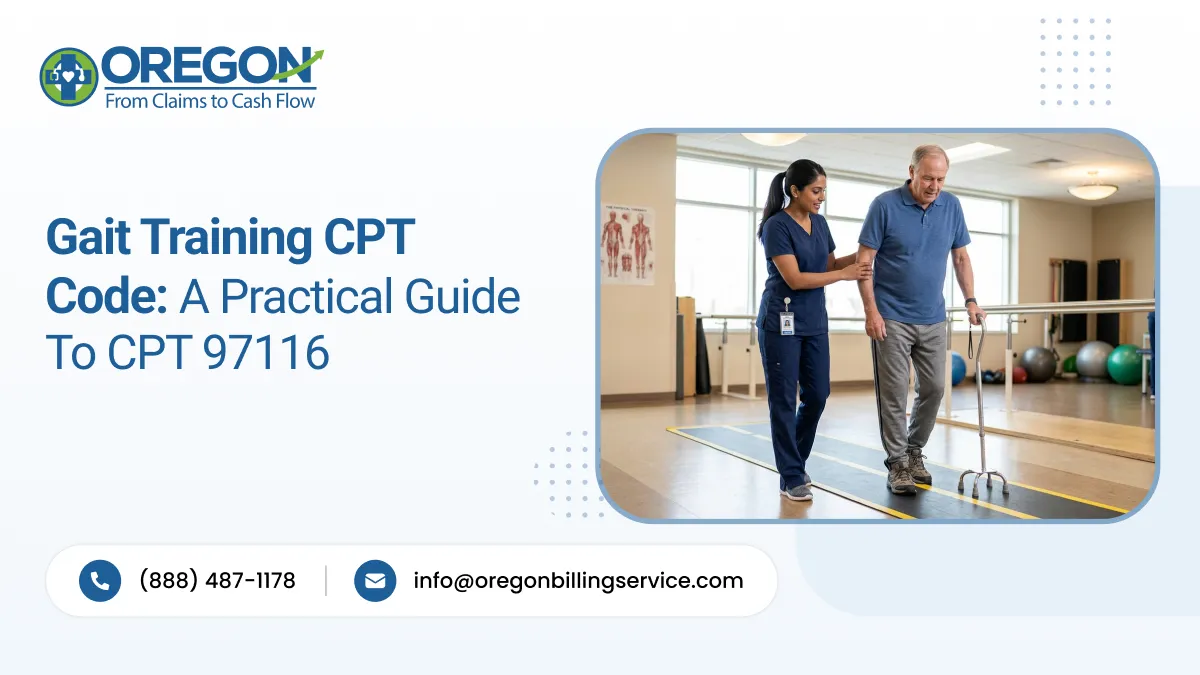
A physical therapist spends 25 minutes helping a stroke patient relearn how to walk with a quad cane. The note simply says, “Gait training, patient ambulated with cane.” The claim goes out with two units of 97116.
Six weeks later, the claim was denied. The note does not show enough skilled intervention, the treatment minutes are unclear, and a required modifier is missing.
The treatment that was given might have been the choice. The issue is that the records don’t clearly back up what was charged. CPT 97116 is the code for gait training but using the right code is only part of the story. The time spent on any modifiers used whether the treatment was needed and the details in the therapy notes all play a role in making sure the claim is properly supported.
In this guide, you’ll learn:
Reimbursement can differ depending on the documents you provide the payer’s policy and the specifics of each visit. Use this as a guide but always double‑check the exact rules, in the patient’s insurance plan.
The CPT code for gait training is 97116. This code is a timed code. It is billed in 15-minute units. The code is used for one- on-one training. The training helps improve how a patient walks. The training helps improve how a patient climbs stairs. The training helps improve how a patient uses a device. Physical and occupational therapists report the code when the service is skilled. Physical and occupational therapists report the code when the service is documented.
The AMA descriptor reads: therapeutic procedure, 1 or more areas, each 15 minutes; gait training (includes stair climbing). Every phrase in it changes how you bill:
The descriptor belongs to the AMA. How Medicare counts the time, which modifiers it wants and when it pays come from CMS and its contractors.
Gait training focuses on changing how a patient walks through skilled instruction and practice. It may include improving step length, weight shifting with an assistive device, stair training, navigating curbs, or walking safely over uneven surfaces. Simply walking with a patient to the bathroom, without providing gait training, does not by itself support 97116.
A useful test for clinicians: Could an aide have done this with no change in outcome? If yes, it probably isn’t a skilled service.
Gait training appears on rehab claims: stroke recovery, joint replacements, Parkinson’s disease, amputation fall prevention. Each unit pays an amount so an error that happens over hundreds of claims adds up quickly.
The hidden costs matter more. Staff hours disappear into corrected claims and appeals. Cash flow slows. And if a post-payment review arrives, billed units that don’t match documented minutes become your problem.
This is where most confusion starts, so let’s slow down.
No. People search for it constantly, but 97116 has no “first 30 minutes” version. The same code repeats for every 15-minute unit. Thirty minutes of gait training alone is typically two units under Medicare’s method.
Under CMS rules in Chapter 5 of the Medicare Claims Processing Manual a single timed service earns one unit when it takes, between 8 and 22 minutes. When you provide timed codes on the same day you add up all the timed minutes first then convert the total.
|
Total timed minutes |
Units billable |
|
8–22 |
1 |
| 23–37 |
2 |
|
38–52 |
3 |
| 53–67 |
4 |
|
68–82 |
5 |
So 7 minutes of gait training alone bills nothing to Medicare. Thirty minutes bills two units.
Take a visit with 20 minutes of therapeutic exercise (97110) and 6 minutes of gait training (97116).
Now the twist. Some commercial payers apply the AMA midpoint rule one code at a time. Under that method, 6 minutes of gait training earns nothing. Same visit, different payment.
Keep a one-page cheat sheet of how each major payer counts time. It takes an hour to build and can prevent a steady drip of underpayments.
If a PT and a PTA are both in the parallel bars for the same quarter hour, you still have one quarter hour. Headcount doesn’t double billable time, and the note should say who did what.
|
GP + GO
The Therapy Discipline Modifiers
|
KX
The Medical Necessity Attestation
|
|
CQ
When a PTA Is Involved
|
59 / X Modifiers
Use Sparingly for Distinct Services
|
Medicare expects a discipline modifier on therapy lines: GP for physical therapy, GO for occupational therapy. Leaving it off is one of the most common reasons claims bounce.
There’s no Medicare therapy cap anymore but once a patient’s therapy spending goes over the annual threshold the KX modifier tells us the care is still medically necessary. For the calendar year 2026 CMS set the threshold at $2,480 for therapy and speech-language pathology combined. There’s also a $2,480 threshold, for occupational therapy. Claims that go over these limits without the KX modifier will be denied. The amounts reset every year. It’s important to check CMSs Therapy Services page to stay updated.
If a physical therapist assistant supplies the service either fully or partially Medicare requires CQ with GP and the payment falls by fifteen percent. Two exceptions are available: time that remains within a ten percent de minimis limit and a final unit in which the physical therapist assistant personally delivered at least eight minutes.
Use “modifier 59” or an appropriate “X modifier, such as XU” only when an NCCI edit applies, the edit permits a modifier, and the services are actually distinct. Simply using a different diagnosis or treating a different body area does not, by itself, justify the modifier.
A word of caution: therapy edits have been removed, added back and removed again. Online lists don’t always match. Always look at the recent quarterly NCCI tables. A modifier indicator of 0 means nothing can change the edit. A modifier indicator of 1 means a modifier can.
Choosing a code starts with what the clinician actually did, not what pays more.
| Code | Best Fit | Watch Out For |
|---|---|---|
| 97116 | Retraining walking, stairs, device use | The skill trained should be the walking task |
| 97112 | Balance, coordination, motor control | Overlaps with gait work, so the note must say what was trained |
| 97530 | Functional tasks like transfers and lifting | Don’t count the same minutes twice |
| 97110 | Strength, range of motion, endurance | Impairment-based, not task training |
| 97150 | Group therapy | Can’t run at the same time as individual 97116 |
| 97760 / 97761 / 97763 | Orthotic and prosthetic management and training | See the device section below |
| 0791T | VR-based gait training (Category III add-on) | Coverage is inconsistent, so verify payer policy |
One Medicare contractor billing article (A56566 in the Medicare Coverage Database) warns against billing 97110, 97112, 97116 or 97530 for the same time period. Even when no edit blocks a pair, a minute only counts once.
Reviewers aren’t looking for long notes. They’re looking for proof of skilled care and expected improvement.
Compare “improve mobility” with “walk 150 feet with a rolling walker at supervision level.” Only one of those gives a reviewer something to check.
Medicare expects periodic progress reports, at least once every 10 treatment days under current manual guidance, and plan-of-care recertification when it’s due. And “no more improvement expected” doesn’t automatically end coverage. Medicare can cover skilled maintenance therapy when a clinician’s skills are needed to maintain function or slow decline, as long as the record explains why.
Here’s something searchers are often surprised by: there isn’t a CPT code for progression. Progression is something your notes have to show.
CPT 97169 to 97172 includes training evaluations and re-evaluations. Whether an athletic trainer can bill for treatment services depends on the payer and state rules. Medicare does not allow athletic trainers to bill directly under Part B. Commercial payers have policies. Always confirm the billing requirements before submitting claims for athletic trainer services.
Some contractors also look harder at gait training that runs long. The contractor article above mentions 12–18 visits within 4–6 weeks, so know your local policy.
97116 says what was done. ICD-10-CM says why. Both belong on the claim, and they do different jobs.
Symptom codes satisfy some payers and look thin to others. Medicare therapy claims generally do better with both the treating diagnosis and the underlying medical diagnosis. The FY 2027 ICD-10-CM code set took effect October 1, 2026, so validate every code against the current set.
Search results lump these together, but they’re three separate billing problems.
Teaching a patient to use a walker or cane is gait training and can go under 97116 when it’s skilled and documented. The walker itself is durable medical equipment, billed by an enrolled supplier with HCPCS Level II codes. 97116 isn’t a way to get paid for the device.
The initial encounter codes are 97760 (orthotic management and training) and 97761 (prosthetic training). 97763 covers later encounters. Billing resources citing CPT guidance say 97760 shouldn’t be reported with 97116 for the same extremity, and when an L code is billed for a custom-fit orthotic, the fitting is included in that payment. If a patient gets device training and separate gait retraining, document each piece distinctly and verify the exact pair against current CPT guidelines and payer policy.
CPT codes 97169 through 97172 are for training evaluation and re-evaluation. These codes do not mean that an athletic trainer can bill CPT 97116 on their own. Medicare does not include trainers as eligible practitioners, for direct Medicare Part B billing. Each commercial payer may have policies and state laws might also vary. Always check the rules before billing for services provided by an athletic trainer.
Catch these issues before a 97116 claim reaches the payer.
What is the CPT code for gait training?
CPT 97116: therapeutic procedure, each 15 minutes, gait training including stair climbing. It’s timed and requires direct one-on-one treatment.
What is the CPT code for gait training for 15 minutes?
One unit of 97116 stands for a 15-minute block. Medicare permits one unit for 8 to 22 minutes of a timed service. The total timed minutes for the day determine the unit count. One unit of 97116 stands for a 15-minute block.
What is the CPT code for gait training for the first 30 minutes?
There’s no separate code. Thirty minutes is generally two units of 97116 under the CMS method. Some commercial payers count differently, so check their policy.
Who can bill 97116?
Physical and occupational therapists, when the service is in scope and a skilled need is documented. Assistants can furnish it under supervision, with CQ or CO applying for Medicare when required. Payer rules, state law and setting all matter.
Does 97116 need a modifier?
For Medicare outpatient therapy, usually GP or GO. Add KX once the annual threshold ($2,480 for PT/SLP combined in 2026) is passed, CQ when a PTA’s share exceeds the de minimis standard, and 59 or an X modifier only where an NCCI edit applies and the services were distinct.
Can 97116 be billed with 97530 or 97112 on the same day?
Often, if the services are separate, the minutes don’t overlap and no current edit or payer policy blocks the pair. Check the current NCCI table.
Is stair training billed separately?
No. The descriptor includes stair climbing.
Why was my gait training claim denied?
Typical reasons are a missing modifier, units that don’t match minutes, overlapping time with another code, weak medical necessity notes, exceeded visit limits or no authorization. The remittance codes point to which one.
Go back to that stroke patient and the quad cane. With minutes recorded, the walking deficit described, the cueing noted and the modifiers attached, the same session becomes a clean, defensible claim. The care didn’t change. The paperwork finally matched it.
If your team is wrestling with unit-count errors, modifier denials or documentation gaps in therapy billing, a professional medical billing team can review your workflow, tighten front-end checks and help your practice follow payer requirements. Reach out to ask about a billing and denial-pattern review for your rehab services.