ICD 10 Code for Congestive Heart Failure (CHF): 2026 Guide
September 15, 2026
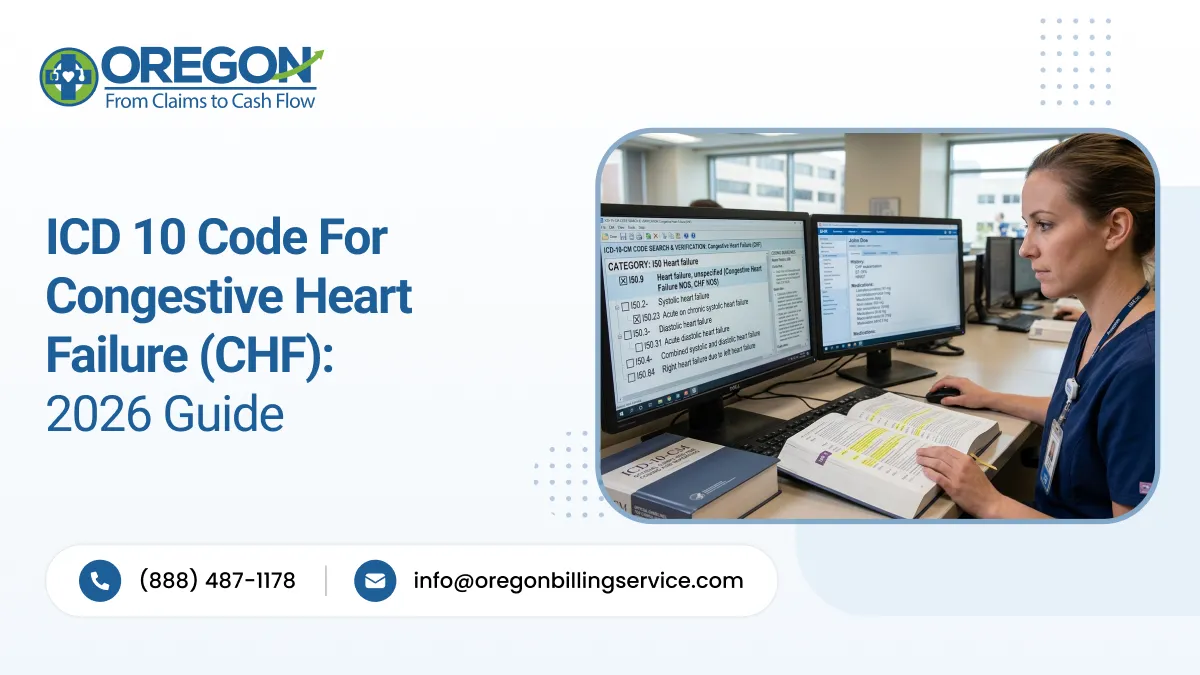
“CHF” is not usually adequate to determine the appropriate ICD-10-CM code.
The type of heart failure and whether it is acute or chronic should be clearly noted in the chart. The code may also be affected by hypertension or CKD. When these details are clear in the record, there is less need to go back and forth with the supplier.
There is more to a heart failure diagnosis than simply identifying the condition. The details can differ from patient to patient, so the provider’s notes should clearly explain how the heart is functioning and whether the condition is new or has been ongoing.
Congestive heart failure (CHF) develops when the heart is unable to pump blood effectively enough to meet the body’s needs. In the clinical documentation or medical record it may defined as acute, chronic, or acute on chronic. The documentation may also identify systolic, diastolic, or combined heart failure. Knowing the difference is vey important when determining the appropriate ICD-10-CM code for the condition.
In coding you may not be able to just document “CHF”. The chart should clearly identify the type and severity of heart failure to provide the most appropriate ICD-10-CM code.
For any type of heart failure, the code is I50.9 Heart failure, unspecified for medical records that solely indicates heart failure or CHF.
The larger category I50 is for heart failure. I50, however, is not a billable diagnosis code. More detailed codes within this category identify distinct types and degrees of acuity.
The numbers on the graphic are counting. The code for chronic systolic heart failure is more explicit, while acute chronic diastolic heart failure is coded under a different category of codes. Accurate differentiation is made possible by clear provider documentation giving coders the information they need.
| Condition | ICD-10-CM Code |
| Heart failure, unspecified | I50.9 |
| Unspecified systolic heart failure | I50.20 |
| Acute systolic heart failure | I50.21 |
| Chronic systolic heart failure | I50.22 |
| Acute on chronic systolic heart failure | I50.23 |
| Unspecified diastolic heart failure | I50.30 |
| Acute diastolic heart failure | I50.31 |
| Chronic diastolic heart failure | I50.32 |
| Acute on chronic diastolic heart failure | I50.33 |
| Unspecified combined systolic and diastolic heart failure | I50.40 |
| Acute combined systolic and diastolic heart failure | I50.41 |
| Chronic combined systolic and diastolic heart failure | I50.42 |
| Acute on chronic combined systolic and diastolic heart failure | I50.43 |
Note: Always Make sure use the ICD-10-CM code set that is effective on the date of service. FY2026 codes will be valid until September 30, 2026 and FY2027 codes will be effective October 1, 2026.
I50.9 is used for heart failure, unspecified when the documentation does not identify a more specific type or acuity.
If the chart just reads “CHF” and doesn’t specify if it’s acute or chronic, or the type of CHF, I50.9 could be the one, but developers should first read the remainder of the documentation. If the supplier has given more particular detail elsewhere in the record that detail may support a more specific code.
This is especially true when a diagnosis of “chronic systolic heart failure” gives significantly more specificity in coding than does “CHF.
With systolic heart failure, the heart muscle has difficulty contracting strongly enough to pump blood effectively. This type of heart failure is often linked to a reduced ejection fraction and may be referred to as heart failure with reduced ejection fraction (HFrEF) in the patient’s medical record.
The ICD 10 code for systolic heart failure depends on whether the condition is unspecified, acute, chronic, or acute on chronic.
When the provider documents persistent systolic heart failure, the appropriate code is I50.22, not the non-specific I50.20.
If documentation contains words such as HFrEF, the provider must verify that the medical record clearly establishes the appropriate heart failure diagnosis and acuity per the documentation and coding criteria being followed.
For this reason, the chronic systolic heart failure ICD 10 code should not be selected simply because a patient has a history of a reduced ejection fraction. The current clinical documentation still matters.
Diastolic heart failure involves impaired relaxation or filling of the heart. It is often associated with preserved ejection fraction and may be documented as HFpEF.
The ICD 10 code for diastolic heart failure is selected according to the documented acuity:
If the physician documents persistent diastolic heart failure, then I50.32 is more specific than an unspecified heart failure code.
I50.33 is the billable code for Acute persistent diastolic heart failure . If the chart displays HFpEF, the clinician should additionally clearly describe the diagnosis of heart failure, not let the ejection fraction speak for itself.
One big difference in heart failure ICD 10 coding is the acuity. The medical record should indicate whether the cardiac failure is:
Acute heart failure refers to a current acute presentation or worsening that is documented as acute. For example, acute systolic heart failure is coded to I50.21, while acute diastolic heart failure is coded to I50.31.
Chronic heart failure describes an ongoing condition. Chronic systolic heart failure is coded to I50.22, while chronic diastolic heart failure is coded to I50.32.
The Acute on chronic heart failure describes an acute worsening of an existing chronic condition. The specific code depends on the type of heart failure.
For example:
Using “acute” and “chronic” accurately in the medical record gives the coding team the information needed to distinguish these conditions.
Some people have both systolic and diastolic dysfunction.
If both are recorded, this is the category applicable: I50.4- (combined systolic and diastolic heart failure).
The codes include:
The important documentation point is to distinguish combined heart failure from a record that merely contains multiple references to heart failure. The diagnosis should be supported by the provider’s documentation.
Another common question involves CHF with hypertension ICD 10 coding.
Under the ICD-10-CM guidelines, hypertension and certain heart conditions are presumed to have a causal relationship when the classification links them through the term “with,” unless the documentation clearly states that the conditions are unrelated.
When hypertension is documented with heart failure, a code from I11.0 — Hypertensive heart disease with heart failure may be assigned, along with an additional code from I50.- to identify the specific type of heart failure.
For providers, this means documentation should clearly reflect the patient’s conditions rather than leaving the coding team to interpret an unclear relationship.
Heart failure may also occur alongside chronic kidney disease and hypertension.
When hypertension, heart disease, and CKD are all present, the ICD-10-CM classification includes combination codes in category I13 — Hypertensive heart and chronic kidney disease. An additional I50.- code identifies the type of heart failure, while an N18.- code identifies the CKD stage when appropriate.
This makes documentation particularly important for patients with multiple chronic conditions. A record that clearly identifies heart failure type, hypertension, and CKD stage gives the coding team a stronger basis for accurate code selection.
Good documentation does not require providers to turn every clinical note into a coding report. It simply needs to clearly communicate the diagnosis and relevant specificity.
When clinically appropriate, consider documenting:
Specify whether the condition is:
Indicate whether the condition is:
When applicable, document conditions such as:
When using words like HFrEF or HFpEF, the diagnosis needs to be documented accurately enough for the coding team to comprehend the illness being treated.
The official coding rules underline the need for full documentation and state that proper coding cannot be accomplished without sufficient information in the medical record.
Not every CHF diagnosis should automatically be coded as unspecified. If the provider documents the type and acuity, a more specific code may be appropriate.
A note that says “heart failure exacerbation” may require additional review if it does not clearly establish whether the condition is acute, chronic, or acute on chronic.
An ejection fraction is clinically important, but providers should not expect the coding team to determine the complete diagnosis from a test result alone. The provider’s diagnostic documentation remains essential.
Hypertension and CKD can affect code selection. These conditions should be documented clearly when they are part of the patient’s clinical picture.
ICD-10-CM codes are updated periodically. The code set applicable to the patient’s date of service should be used rather than relying on an older online reference. The CDC maintains the official ICD-10-CM releases and browser resources.
Accurate diagnosis documentation affects more than the diagnosis list in a patient’s chart. It can influence claim accuracy, medical necessity reporting, payer review, and the information available to support the services billed.
For providers, the goal is not simply to choose the longest or most detailed code. The goal is to ensure that the code reflects the diagnosis that is actually documented.
When documentation and coding are aligned, there is less need for unnecessary clarification and fewer opportunities for avoidable coding errors.
ICD 10 code for congestive heart failure is not usually one code. If the documentation for heart failure does not specify the type, I50.9 can be used although more precise possibilities are available in the ICD-10-CM classification, including systolic, diastolic, mixed, acute, chronic, and acute on chronic heart failure.
Good documentation is step one for providers. It is important for the coding team to know the kind and severity of heart failure and conditions that exist along with heart failure that apply to the patient. This is needed to select the correct code.
What is the ICD 10 code for CHF?
When CHF is documented without further specificity, I50.9 — Heart failure, unspecified may apply.
Is I50.9 a billable ICD-10-CM code?
Yes. I50.9 is a specific code for heart failure, unspecified. The broader I50 category is not itself a billable code.
What is the ICD 10 code for chronic systolic heart failure?
I50.22 is the code for chronic systolic heart failure.
What is the ICD 10 code for chronic diastolic heart failure?
I50.32 is the code for chronic diastolic heart failure.
What is the ICD 10 code for acute on chronic heart failure?
The code depends on the type. Examples include I50.23 for acute on chronic systolic heart failure and I50.33 for acute on chronic diastolic heart failure.
How is heart failure with hypertension coded?
When hypertension is documented with heart failure, an applicable code from I11.0 may be used along with an additional I50.- code identifying the type of heart failure, following ICD-10-CM guidelines.
Can providers use CHF as the diagnosis?
Providers may document CHF, but adding clinically supported specificity such as systolic or diastolic type and acute or chronic status can provide the coding team with more information.