ICD-10 Code for Minimally Invasive Procedures: A Provider Guide
September 18, 2026
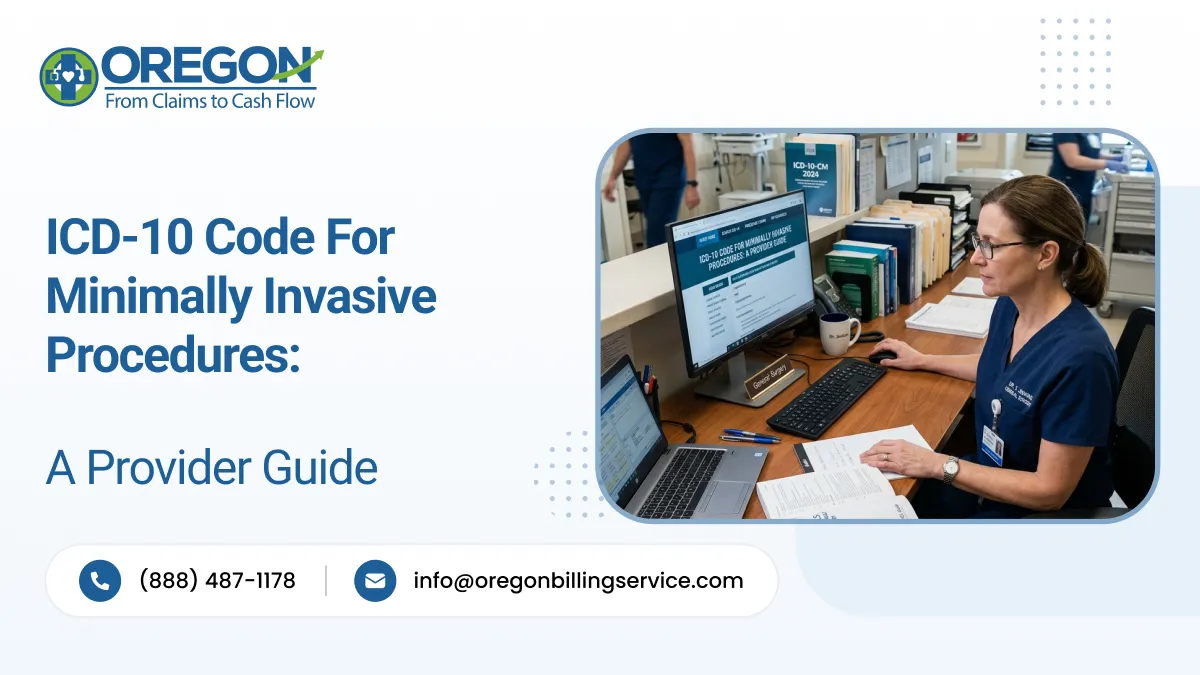
A note that simply says “minimally invasive procedure” may sound clear, but it does not give a coder enough information to select the right procedure code. That’s because minimally invasive describes the technique, not the specific procedure performed.
The right classification is dependent on what was done, where it was done, the surgical method, and other details noted in the operative report. Providers: Clear documentation of procedures is the key to proper coding and helps avoid unnecessary coding questions and rework.
The difference concerns physicians and practice administrators since a procedure note that just says “minimally invasive surgery” does not provide the coding team enough information to select a comprehensive ICD-10-PC S code.
“Minimally invasive” is a descriptor of a surgical approach, not a specific treatment.
A surgeon may employ a minimally invasive technique for a colon resection, a gallbladder surgery, a kidney procedure, a vascular intervention or other operation. Each of the techniques has different coding considerations.
For applicable inpatient procedures, ICD-10-PCS breaks the procedure down into several elements. These include the:
The approach is particularly relevant to minimally invasive procedures. ICD-10-PCS includes approaches such as Percutaneous and Percutaneous Endoscopic, along with Open and other defined approaches.
So instead of just asking which code represents “minimally invasive surgery,” the better question is: What procedure was performed, which part of the body was involved, and how did the surgeon reach the site? The reason is to determine where the procedure falls in the ICD-10-PCs
The phrase “ICD-10” often gets used as a general term, but ICD-10-CM and ICD-10-PCS aren’t used for the same purpose.
|
Diagnosis
ICD-10-CM
Used for diagnosis coding — the condition being treated.
|
Procedure
ICD-10-PCS
Used for applicable inpatient procedures performed during a hospital stay.
|
A patient may therefore have an ICD-10-CM code describing the condition that led to treatment and an ICD-10-PCS code describing the applicable inpatient procedure.
That distinction becomes especially useful when a provider is searching for a “minimally invasive ICD-10 code.” The search may actually be referring to three different coding needs: the diagnosis, an inpatient procedure, or a professional procedure reported with CPT.
CPT is separate from ICD-10-PCS. CPT codes are used to report physician and other professional services and procedures. There isn’t a single CPT code called “minimally invasive procedure” either. The specific procedure has to be identified before the appropriate CPT code can be determined.
For instance, just because a technique is minimally invasive does not mean it should be coded with a CPT code.
The approach is one of the details that can change the final ICD-10-PCS code.
For applicable procedures, ICD-10-PCS distinguishes approaches such as Open, Percutaneous, and Percutaneous Endoscopic.
That means two procedures involving the same general body part can have different codes when they are performed through different approaches.
A percutaneous procedure reaches the treatment site through a puncture or small access point rather than exposing the area through an open incision. This approach is used for a range of procedures. The exact code still depends on what was done after the site was reached. The access method should be clear in the operative documentation when it affects code selection.
A percutaneous endoscopic procedure uses an endoscope to visualize the operative site through a percutaneous access point. This approach is relevant to many laparoscopic procedures.
However, the word “laparoscopic” alone should not be treated as the entire coding answer. The coder still has to identify the procedure, body part, root operation, and other required characters.
In a few cases yes because the coding approach is based truly on the ICD-10-PCS definition and the way the procedure was actually performed, not simply on whether the surgeon describes the procedure as minimally invasive.
CMS provides guidance for procedures involving endoscopic assistance and incision extensions, including situations in which the appropriate approach remains Open. This is why the operative report needs to describe the technique rather than relying on a broad label such as “minimally invasive.”
“Minimally invasive” describes the overall surgical approach, not the name of a specific surgery.
A procedure may be started laparoscopically or with another minimally invasive approach and then converted to an open approach. If this occurs, the operative record should document the change in approach, the reasons for the change when clinically relevant and how the procedure was performed.
For providers, the important point is to document what actually happened, not just the original surgical plan. The coding team uses the completed procedure and applicable ICD-10-PCS guidelines to determine the appropriate approach and code.
Looking at actual codes makes this distinction easier to understand.
For example, the FY2026 ICD-10-PCS code set contains separate codes for excision of the large intestine based on the approach.
The important takeaway isn’t memorizing these three codes.
It’s seeing how the approach changes the final code even when the underlying procedure is an excision of the large intestine.
The FY2026 code set also contains more specific examples involving portions of the large intestine, including right and left large intestine and the cecum, with different approaches represented in the code structure.
For an actual claim, coders should use the current ICD-10-PCS tables and guidelines applicable to the patient’s discharge date rather than relying on an example from an article.
Laparoscopic and robotic procedures can create confusion because the operative technique may involve several small incisions, an endoscope, specialized instruments, or an additional incision for specimen removal.
A small incision by itself does not determine the ICD-10-PCS approach.
CMS provides specific guidance for laparoscopic procedures performed with hand assistance or with an incision extension used to remove a body part or complete an anastomosis. Certain procedures in these circumstances continue to use the Percutaneous Endoscopic approach.
The CMS guidelines give examples including:
This is also why “robotic surgery” should not be treated as a standalone ICD-10-PCS approach. The coding team still needs to determine how the procedure was performed and apply the appropriate PCS definitions.
If you’re a provider you don’t need to turn an operative code into some coding manual, the record should be simple. That should describe the procedure clearly enough for the coding team to understand what happened and what services were performed.
The very first thing is to name what procedure was performed, such as an excision, resection, repair, drainage, release, or another specific procedure.
Identifying the body part while selecting the ICD-10-PC code also matters. If a procedure involves the intestine for example, the documentation may need to distinguish the specific portion involved rather than simply stating “bowel surgery.”
When relevant, identify whether the procedure was performed using an open, percutaneous, laparoscopic, endoscopic, or other applicable approach.
The documentation does not have to copy ICD-10-PCS terminology word-for-word. It does need to describe the procedure accurately enough for the coding team to apply the appropriate definition.
If a device is left in the body after the procedure, document what was placed and where it remains. Temporary instruments used during surgery do not automatically represent an ICD-10-PCS device. The coding team applies the applicable PCS guidelines to determine whether a device should be reported
If a device was used or left in place, or if another procedural detail affects code selection, include it in the operative report.
If more than one procedure was performed, each procedure should be clearly described rather than left for the coding team to infer from the narrative.
Consider the difference between these two descriptions.
Less specific:
“Minimally invasive colon surgery performed.”
The description tells us very little about the actual operation.
Now consider:
More specific:
“Laparoscopic excision of the documented portion of the large intestine using a percutaneous endoscopic approach.”
The second description gives the coding team much more information to evaluate. The point isn’t that every operative note needs to contain a long list of coding terms. It is that the medical record should accurately describe the procedure, site, and technique.
When those details are missing, the coding team may need to contact the provider for clarification rather than make an assumption.
|
Coding Documentation Review
Is Your Procedure Documentation Creating Coding Questions?
If your practice regularly receives coding queries, sees procedure-code corrections, or has operative notes that require clarification, a focused coding review can help identify where documentation may be creating problems.
|
Find documentation gaps before they lead to repeated coding questions.
|
Choosing the right coding is very important; it can prevent the chances of errors and denials.
The phrase describes the technique. It does not identify the complete procedure.
Minimally invasive procedures can fall under different ICD-10-PCS approaches. The approach needs to match the procedure documented in the record.
Laparoscopic technique is only one part of the coding picture. The body part, root operation, approach, device, and qualifier may all affect the final code.
There is no generic “robotic” approach that replaces the ICD-10-PCS approach selection. The operative technique must be evaluated under the applicable coding rules.
ICD-10-PCS is updated regularly. The applicable code set should be based on the relevant discharge period.
This is particularly important around the annual October 1 transition. CMS has published FY2027 ICD-10-PCS materials for the period beginning October 1, 2026.
A quick review of the operative note can help catch missing information before it becomes a coding query.
Before signing the note, ask:
What was performed?
The actual procedure should be identifiable.
Where was it performed?
The relevant anatomical site should be clear.
How was it performed?
Document the surgical approach and technique when they affect the procedure description.
What happened to the tissue or body part?
State whether it was excised, resected, repaired, drained, released, or otherwise treated.
Was a device used or left in place?
Include relevant device information.
Were additional procedures performed?
Describe them clearly rather than leaving them implied.
This takes less time than resolving a documentation query after the procedure has already moved through the coding process.
Not every procedure requires outside coding support. A review may make sense when a practice is dealing with a pattern of problems rather than an isolated question.
For example:
A professional coding review can compare the documentation with the applicable coding guidelines and identify where the record supports a code or where provider clarification is needed.
The goal is not to force a more specific code. It is to make sure the selected code reflects what the medical record actually supports.
There isn’t one ICD-10 code for minimally invasive procedures.
The procedure itself determines the coding path. For applicable inpatient procedures, ICD-10-PCS considers details such as the body part, root operation, approach, device, and qualifier. The approach may be Percutaneous, Percutaneous Endoscopic, Open, or another defined approach, depending on the procedure.
For physicians and practice administrators, the most useful takeaway is simple: document what you actually performed and how you performed it.
“Minimally invasive” can describe the technique, but it isn’t enough by itself to establish a complete procedure code.
Is there one ICD-10 code for minimally invasive surgery?
No. Minimally invasive surgery includes many different procedures, so the applicable code depends on the specific procedure and its documented details.
Is minimally invasive surgery coded with ICD-10-CM or ICD-10-PCS?
ICD-10-CM is primarily used for diagnosis coding. ICD-10-PCS is used for applicable inpatient procedure coding.
What ICD-10-PCS approach is commonly associated with laparoscopic procedures?
Many laparoscopic procedures use the Percutaneous Endoscopic approach when they meet the ICD-10-PCS definition. The operative documentation still needs to support the approach.
Does robotic surgery have a separate ICD-10-PCS code?
There is no generic ICD-10-PCS “robotic” approach. The appropriate code depends on the actual procedure and the approach defined by ICD-10-PCS.c
Can a minimally invasive procedure use the percutaneous approach?
Yes. Applicable procedures performed through percutaneous access may use the Percutaneous approach under ICD-10-PCS.
What should a provider document for minimally invasive procedure coding?
The operative note should clearly identify the procedure, anatomical site, operative approach, relevant technique, and other details that affect code selection. If the record does not provide enough information, the coding team may need clarification from the provider.