Mood Disorder ICD-10-CM Codes: A Guide for Providers
October 29, 2026
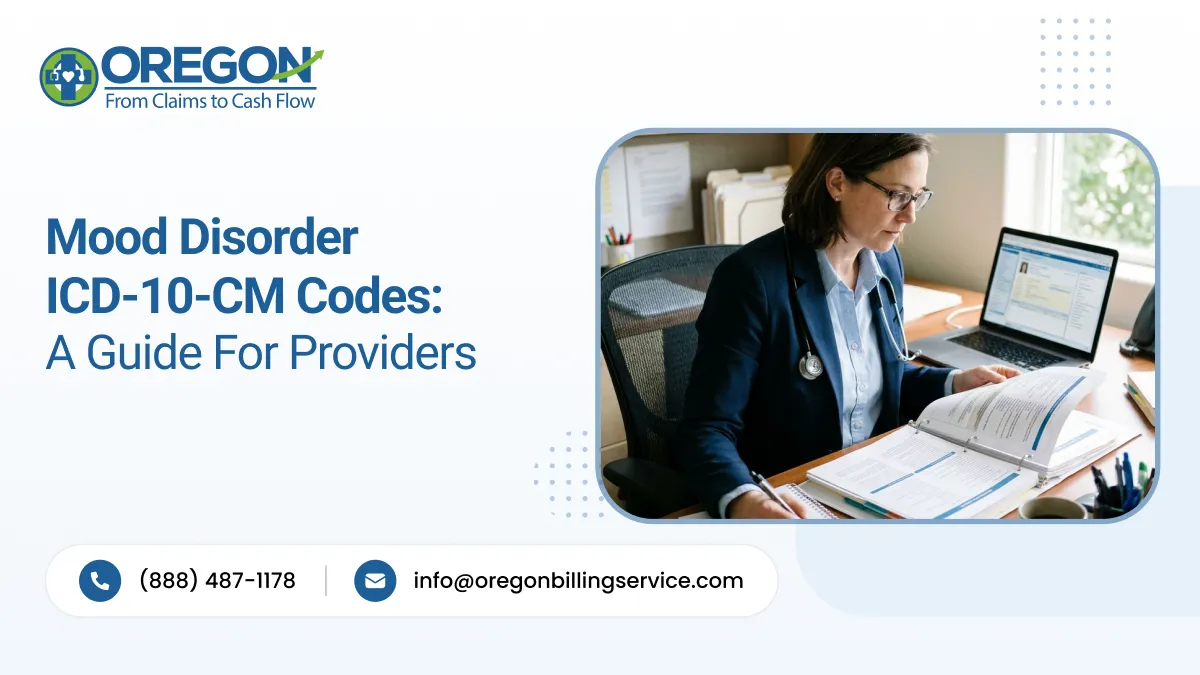
A patient visits a behavioral health practice with persistent irritability, depressive symptoms, and unpredictable mood changes. The provider completes a psychiatric evaluation, but the findings do not yet support a specific depressive or bipolar disorder diagnosis. Which Mood Disorder ICD code should the practice report, and what documentation supports that decision?
ICD-10-CM code F39 stands for Unspecified Mood Disorder. The use of code F39 is only indicated when there is evidence that the provider has made an assessment of an unspecified mood disorder; however, the presence of any problem that is mood-related does not necessarily mean the use of this code. Proper coding will require proper diagnosis, relevant clinical information, and consideration of classification guidelines.
Mood disorders affect millions of Americans and can disrupt daily functioning, relationships, and overall health. According to SAMHSA’s 2025 National Survey on Drug Use and Health, 19.7 million U.S. adults (7.4%) experienced a major depressive episode in 2025.
According to the report, 57.3 million adults had been treated for any kind of mental disorder. In case of adults who were experiencing major depression, 65.9 percent were under treatment, but 6.4 million adults had never gone for mental disorder treatment or mental support services.
A timely clinical assessment enables health care providers to diagnose and treat the patients individually. As mentioned by the National Institute of Mental Health, psychotherapy and medication are proven treatments of depression. Accurate clinical documentation is also essential in order to code the mood disorders ICD-10-CM accurately.
Major Depressive Episode
U.S. adults · 7.4% · 2025
Mental Health Treatment
U.S. adults · 21.6% · 2025
Depression Treatment Received
Adults with a major depressive episode
Neither Treatment Nor Other Services
Adults with a major depressive episode
ICD-10 coding for mood disorder is dependent on the diagnosis provided by the treating healthcare provider. The code F39 is assigned for Unspecified mood [affective] disorder, if there is documentation of a mood disorder that cannot be further classified.
Depressive disorder, bipolar disorder, and mood disorder because of physiological conditions have their own categories under ICD-10-CM.
The table provided below illustrates the corresponding ICD-10-CM codes that are applicable from October 1, 2026 through September 30, 2027.
| ICD-10-CM Code | Official Description | Coding Consideration |
|---|---|---|
| F39 | Unspecified mood [affective] disorder | For an established mood disorder without further diagnostic specification. |
| F06.30 | Mood disorder due to known physiological condition, unspecified | Physiological cause documented; mood features unspecified. |
| F06.31 | Mood disorder due to known physiological condition with depressive features | Documented physiological cause with depressive features. |
| F06.32 | Mood disorder due to known physiological condition with major depressive-like episode | Documented physiological cause with major depressive-like episode. |
| F06.33 | Mood disorder due to known physiological condition with manic features | Documented physiological cause with manic features. |
| F06.34 | Mood disorder due to known physiological condition with mixed features | Documented physiological cause with mixed features. |
F06.3 categories have an instructional note for the underlying physiological disorder that coders are required to use and consider before coding any diagnosis from this category.
There are also Excludes2 notes for mood disorders due to alcohol or other psychoactive substance use as well as mood disorders not due to any known physiological disorder in the F06.3 categories. These notes are used for distinguishing diagnostic categories and not for determining multiple diagnoses.
Providers and coding teams can consult the CDC’s official ICD-10-CM files and FY 2027 coding guidelines when reviewing diagnosis reporting requirements.
This code means that there exists a mood disorder of unknown cause. This means that the mood disorder has been diagnosed by the healthcare professional, but documentation is missing to categorize the mood disorder in another category.
Unspecified only refers to the extent of documentation available for the particular disorder. This code does not imply that the healthcare provider has made any kind of incorrect diagnosis or treatment for the condition.
For example, a psychiatric nurse practitioner could have made a diagnosis of a mood disorder of clinical significance, and continued the assessment of the patient’s symptoms, previous episodes, and drug reactions.
If the assessment shows that the patient has an unspecified mood disorder, then F39 may well be an appropriate diagnostic code based on the documentation.
But “mood swings” or “depressed mood” does not necessarily mean F39.
Consider an instance whereby a patient thinks that he or she has experienced episodes of mood swings, irritability, low motivation, and difficulty in carrying out everyday activities.
The psychiatrist looks into the medical history of the patient, examines the symptoms exhibited by the patient, searches for alternative reasons, and concludes that the patient is suffering from “an unspecified mood disorder.”
The healthcare professional formulates a therapy regimen without diagnosing a major depression disorder, bipolar disorder, or any other illness.
In such cases, F39 could be the right choice according to the documentation.
The billing department needs to make sure that the diagnosis is included in the provider’s assessment and that documentation justifies its application to the case.
Choosing an unspecified code does not mean making the wrong decision. The critical point is whether the selected code corresponds to the diagnosed disease.
Coding clarification becomes appropriate when the medical record contains conflicting or unclear diagnostic information.
For instance, the provider’s assessment may reveal bipolar disorder but the billing worksheet shows an unspecified mood disorder. The opposite may happen where a particular section of the note reveals a physiological factor but the final assessment fails to link the two.
These differences deserve review before claim submission.
A coding professional should seek clarification when:
The objective is to accurately represent the provider’s clinical judgment, not to encourage unsupported diagnostic specificity.
Types of affective [mood] disorders can be identified. Even if they share similarities, it is the type of disorder which determines its diagnosis, along with other parameters.
The above information allows providers to accurately convey their findings and the billing team not to confuse the corresponding psychiatric terms.
The mood disorder related to a general medical condition differs from the primary mood disorder in that the existence of causality between the mental and the medical disorder is determined by the physician.
For instance, a patient may develop mood disturbance due to his or her neurological or endocrine disease; however, the presence of these two disorders does not mean the existence of any causality between them.
The F06.3 category provides several levels of diagnostic specificity:
Consider a patient with an established neurological disease who is then diagnosed with a mood disorder due to that neurological disease and who also happens to have depressive features.
This would be coded under F06.31 provided that all the requirements for classification have been fulfilled according to the records. The coders must first establish the physiological diagnosis.
However, where there is just a diagnosis of a neurological disease and depression but no clear evidence that the former led to the latter, the coders cannot use F06.3.
The ICD-10-CM official coding guidelines emphasize complete documentation and require coders to follow classification instructions.
Bipolar disorder is classified among mood disorders; however, a distinct bipolar diagnosis will have its own distinct code under ICD-10-CM.
F31 is the ICD-10-CM code for bipolar disorder diagnosis coding, with the choice of the code being dependent on the condition and episodes of the patient.
The evaluation of patient history is made on the basis of mania, hypomania, and depression episodes
According to the National Institute of Mental Health, “bipolar disorder is the mood changes that encompass changes in mood, behavior, activity, and energy level.” The evaluation comprises the occurrence, duration, history, and intensity of such episodes.
A person with irritability and mood changes is not necessarily coded as having a bipolar disorder.
In the same way, if a bipolar disorder has been diagnosed by the physician, the coding of the condition using F39 is wrong, in case the individual presents mood changes.
Coding example: If the psychiatrist has diagnosed bipolar disorder with the presence of current episodes, the coder needs to look at the F31 codes and then code the condition using F31.
Another type of disorder that falls within the mood disorders is the depressive disorder.
ICD-10-CM codes for major depressive disorders include the codes F32 and F33 to differentiate specific clinical features such as presence of episodes and severity when present.
An existing depressive disorder will then need a different code than the unspecified mood disorder.
Symptoms such as sadness, low energy levels, inability to concentrate, and sleep problems are just some of the indicators that might help in the diagnosis by the provider, but are not an indication of major depressive disorder.
The NIMH depression resource highlights the process through which physicians evaluate the duration, frequency, impact on functioning, and other possible causes of these symptoms.
For example, in the case where the family doctor diagnoses major depressive disorder, it would be crucial to find out the most suitable code in the depressive disorder classification based on the seriousness of the disorder, and not give the wrong code such as F39.
In any case, the key difference is quite clear – the diagnosis defines the appropriate category, regardless of the presence of individual mood symptoms.
Recording information about mood disorders must begin with a thorough psychiatric assessment. The practitioner should describe what has been discovered about the patient during this consultation and how it is relevant to diagnosing and treating the illness.
For billing teams, well-organized documentation makes diagnosis code selection more straightforward and helps identify discrepancies before claim submission.
The final assessment should clearly identify the psychiatric diagnosis when the clinical evaluation supports one.
A statement such as “patient experiencing irritability and mood changes” describes symptoms but does not necessarily establish a mood disorder.
Such an assessment includes providing a more accurate diagnosis of “Unspecified Mood Disorder” or something similar where applicable.
The importance of the issue to the visit must be defined by the clinician so that the problem can be determined as being assessed, treated, managed, etc.
Language used for diagnosis ensures that the billing department is able to distinguish between established issues and complaints or other issues.
Certain mood disorder ICD-10-CM categories require more specific clinical information.
For instance, bipolar disorder may be assigned a code based on the recorded episode and severity, while F06.3 differentiates between depressive episodes, major depressive episode-like episodes, manic episodes, and mixed episodes.
The provider needs to make sure that all these considerations are noted in the records where they are significant components of the diagnosis.
Information relevant to the evaluation process may involve symptom duration, frequency, function changes, episode history, exam findings, and patient reaction to treatment.
But making additional notes just to justify a more specific code will compromise the accuracy of the record-keeping process.
The goal is clinical accuracy, not maximum coding specificity.
For example, a case of a patient with lack of motivation, insomnia, fatigue, and mood swings is presented. The physician writes down the symptoms and makes an appointment for him. At this point, there is no diagnosis of depression or bipolar disorder yet.
In this case, it is not right for the billing department to make the diagnosis based on the symptoms provided by the patient. The coder must code the appropriate condition or symptom based on the guidelines, if applicable, and ask appropriate questions.
Another important thing is that consideration must be given to how the above mentioned cases will be documented by the clinician. In general, the outpatient ICD-10-CM guidelines do not permit the coding of uncertain diagnoses as definite diagnoses.
The consistency of documentation is very essential when coding for the diagnosis of the patient through the revenue cycle.
It is very important to compare the reported diagnosis with that provided by the doctor when creating a claim.
A practical review should confirm:
If the record contains conflicting information, the practice should resolve the discrepancy through an appropriate provider clarification process.
Practices that need assistance with these reviews can explore professional medical coding services to strengthen documentation consistency and coding workflows.
Mood disorder claims can become difficult to process when diagnosis reporting does not align with clinical documentation. Recognizing common errors helps practices address issues before they create unnecessary administrative work.
F39 should not become the default diagnosis whenever patients report sadness, irritability, emotional instability, or mood swings.
A provider must establish an unspecified mood disorder before the coder assigns that diagnosis.
Otherwise, the claim may report a psychiatric condition that the assessment does not support, potentially requiring clarification or correction.
A broad mood disorder diagnosis does not automatically establish bipolar disorder or major depressive disorder.
Likewise, clearly documented bipolar or depressive diagnoses should not be replaced with F39 merely because it offers a broader description.
Such substitutions can create inconsistencies between clinical notes, diagnosis reporting, and treatment documentation.
Billing teams should follow the provider’s established diagnosis and verify the corresponding classification.
A patient may have both a chronic medical condition and mood-related symptoms without having a mood disorder caused by that condition.
For example, a patient’s endocrine disorder and depressive symptoms may coexist, but the clinician must establish the relevant causal relationship before the coder uses the F06.3 classification.
Unsupported assumptions may result in inaccurate diagnosis reporting or additional documentation review.
Selecting a code based on its description alone can lead to errors.
Coders should review relevant inclusion terms, exclusion notes, code-first requirements, and other applicable classification instructions.
The F06.3 family requires particular attention because its parent category instructs coders to report the underlying physiological condition first.
Ignoring that requirement may create sequencing errors that require claim corrections.
Practices must use the code set appropriate to the patient’s date of service.
FY 2027 ICD-10-CM applies to services from October 1, 2026, through September 30, 2027.
Claims for services before October 1, 2026, require the applicable FY 2026 release. For services provided between April 1 and September 30, 2026, the April 2026 update applies.
Even when a particular diagnosis code remains unchanged, practices should review the applicable annual classification and coding instructions.
Using outdated references can lead to unnecessary corrections, rejected submissions, or inconsistent reporting.
Behavioral health medical billing depends on more than choosing a diagnosis code. Practices must connect the documented psychiatric condition to the services delivered, the provider’s assessment, and the applicable payer requirements.
When clinicians document diagnoses clearly, billing teams can review claims without repeatedly interpreting incomplete or contradictory notes.
Accurate coding also helps practices identify discrepancies before submission. For example, a pre-claim review may uncover a mismatch between a psychiatrist’s documented depressive disorder and an unspecified mood disorder code entered in the practice management system.
Correcting that mismatch early can prevent unnecessary administrative follow-up.
A structured behavioral health billing workflow helps staff:
These steps support more efficient claim review and reduce avoidable documentation clarification requests.
However, correct diagnosis coding does not guarantee insurance reimbursement. Eligibility, benefit limitations, medical necessity, prior authorization, provider enrollment, and payer-specific policies also influence claim processing.
Practices may use medical billing support to coordinate claim submission, administrative follow-up, and revenue cycle management while maintaining provider responsibility for clinical diagnosis.
Oregon healthcare providers follow the applicable national ICD-10-CM classification when reporting psychiatric diagnoses. The diagnostic coding framework does not change simply because a practice operates in Oregon.
However, payer-specific requirements may affect how behavioral health services are billed, documented, and reviewed.
The Oregon Health Authority provides billing resources for services covered through the Oregon Health Plan (OHP). Its guidance addresses benefit coverage, provider qualifications, documentation, billing procedures, and restrictions on certain services.
OHA also explains that valid procedure codes do not automatically qualify for coverage in every setting. Providers should review the relevant coverage requirements and the applicable Prioritized List of Health Services.
Oregon practices should confirm the patient’s coverage and identify the correct payer arrangement before claim submission.
For OHP members, teams should determine whether the claim follows the applicable coordinated care organization requirements or OHP fee-for-service rules.
They should also review any relevant authorization, provider-type, service documentation, and billing requirements.
The Oregon Health Authority’s OHP billing guidance and behavioral health rules and guidelines provide official starting points.
Commercial insurers may impose different administrative requirements, so practices should not assume that every payer follows identical claim submission policies.
For psychiatric practices, consistent diagnosis reporting and informed payer review help keep clinical documentation and administrative processes aligned.
What Is the ICD-10-CM Code for Mood Disorder?
F39 represents unspecified mood [affective] disorder. However, the appropriate mood disorder ICD-10 code depends on the established diagnosis. More specific depressive, bipolar, or physiologically related mood disorders require their applicable classifications.
What Does F39 Mean in Medical Coding?
F39 means “Unspecified mood [affective] disorder.” It describes an established mood disorder that the clinician has not classified more specifically. It does not automatically apply to patients who report mood-related symptoms without a documented diagnosis.
Is F39 the Same as Bipolar Disorder?
No. F39 identifies an unspecified mood disorder, while bipolar disorder generally falls under the F31 category. Coders should use the appropriate classification based on the provider’s documented diagnosis.
How Is a Mood Disorder Due to a Physiological Condition Coded?
The F06.30 through F06.34 codes distinguish unspecified, depressive, major depressive-like, manic, and mixed features. The provider must establish the relationship to the physiological condition, and coders must follow the instruction to report the underlying condition first.
Can a Coder Assign a Mood Disorder Diagnosis Based on Symptoms?
No. Coders cannot independently establish a psychiatric diagnosis from symptoms such as sadness, irritability, or mood changes. They must follow the documented assessment and applicable ICD-10-CM coding guidelines.
Which ICD-10-CM Code Set Applies to Services in 2026?
FY 2026 applies to services from October 1, 2025, through September 30, 2026, subject to the April 1, 2026 update for later dates within that period. FY 2027 applies beginning October 1, 2026. The date of service determines the applicable code set.
Accurate mood disorder coding requires clear clinical documentation, appropriate ICD-10-CM code selection, and consistent claim review. These steps help psychiatric and behavioral health practices maintain reliable diagnosis reporting without adding unnecessary administrative work.
Oregon Billing Service offers medical coding services in Oregon for healthcare organizations seeking assistance with coding reviews and revenue cycle workflows.
Explore our services to see how your practice can strengthen its billing processes while allowing providers to focus on patient care.