Pediatric CPT Codes by Age Group: 2026 Coding Guide for Providers
September 4, 2026
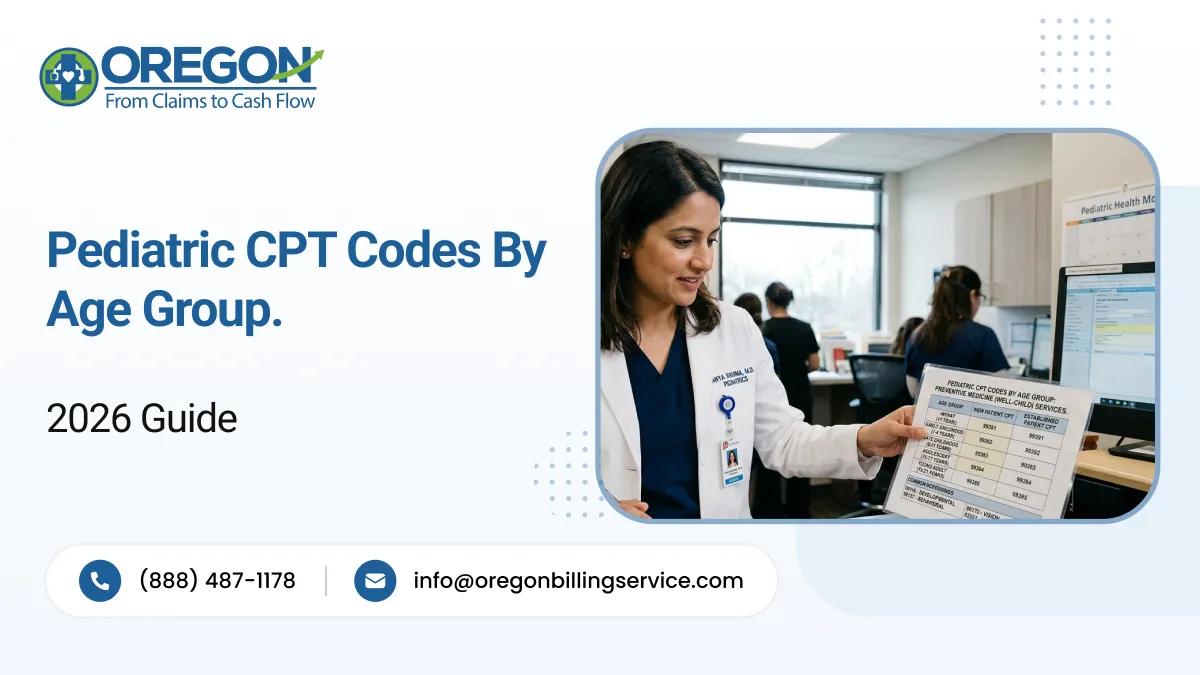
Many preventative visits require code selection based on the patient’s age, new or established status, kind of encounter, paperwork, and services performed.
This is particularly relevant for pediatric clinics, as well-child visits are typically multi-component and entail preventive evaluation and treatment, developmental screening, vision or hearing services, immunizations, counselling, and sometimes a separate problem-oriented evaluation .
Providers and billing teams also need to be aware of the new CPT® codes for stand-alone immunization counselling when vaccines are not provided on the same date for 2026.
This article provides the most relevant pediatric preventive medicine codes by age group, and reviews coding decisions that may affect accurate billing and payment.
Not every pediatric CPT code is determined by age. However, preventive medicine evaluation and management codes are divided into specific age ranges.
The first decision is whether the patient is new or established for the reporting provider. The next is the patient’s age on the date of service.
For preventive visits, the basic age groups are:
The American Academy of Pediatrics’ 2026 preventive coding resources specifically cover preventive services from birth through age 21 and include the applicable evaluation and management and additional service codes.
For a routine well-child or health supervision visit, the preventive medicine E/M code is selected according to the patient’s age and whether the patient is new or established.
| Age Group | New Patient | Established Patient |
|---|---|---|
| Under 1 year | 99381 | 99391 |
| 1–4 years | 99382 | 99392 |
| 5–11 years | 99383 | 99393 |
| 12–17 years | 99384 | 99394 |
| 18–39 years | 99385 | 99395 |
These age ranges are part of the preventive medicine E/M code structure.
For an infant receiving a preventive medicine service, the appropriate code depends first on patient status.
99381 = Preventive visit new patient 99391 = Preventive visit established patient
The visit may involve history and examination suitable to age, anticipatory guidance, risk assessment, and recommended preventive services.
However, providers should not assume that the preventative E/M code captures all of the services provided during the encounter. There may be separate reporting requirements for screenings, immunizations and other services.
For children from 1 through 4 years, the applicable preventive medicine categories are 99382 for new patients and 99392 for established patients.
This age range includes several important developmental stages, so documentation should accurately reflect the preventive assessment and services performed during the encounter.
For school-age children, preventive visits fall into the 99383 category for new patients and 99393 for established patients.
This is also an age range where practices may report additional screening or assessment services when those services are performed and appropriately documented.
For adolescents, the preventive medicine categories are 99384 for new patients and 99394 for established patients.
Documentation should support the preventive nature of the encounter, including appropriate history, examination, counseling, anticipatory guidance, and risk assessment.
Although pediatric practices may primarily care for patients under 18, some practices continue caring for young adults.
The preventive categories move to 99385 for new patients and 99395 for established patients for ages 18–39.
Age alone does not determine the preventive code.
The clinic also needs to assess if the patient is new or established under the applicable CPT criteria.
This can become especially important when a child starts seeing a different provider, switches to another pediatrician within the same healthcare system, or relocates to a different area.
A common coding mistake is selecting the age-appropriate code without verifying patient status first.
A better workflow is:
This approach reduces the risk of choosing a code based solely on age.
Newborn care should not automatically be treated as a routine office preventive visit.
AAP’s 2026 coding resources separately address newborn coding and decision-making, reflecting the different coding considerations involved in initial and subsequent newborn services.
As such, the billing team should determine the location and conditions under which the newborn care was performed so that the correct preventative medicine code can be chosen.
This is an important distinction because the coding system is different for hospital care for infants than for routine pediatric office well-child visits.
A preventive E/M service may be only one component of a pediatric encounter.
AAP describes a pediatric preventive visit as typically including the preventive E/M service along with recommended screenings, tests, and immunizations.
Depending on the services performed and the applicable coding and payer rules, additional reporting may include services such as:
The important point is that the provider should not report an additional code simply because a service is commonly performed during well-child visits.
The service must be performed, documented, and separately reportable under the applicable coding and payer requirements.
One of the most notable pediatric coding changes for 2026 involves stand-alone immunization counseling.
New CPT codes 90482–90484 were introduced for immunization counseling provided by a physician or other qualified healthcare professional when the recommended immunization is not administered on the same date.
These codes are time-based:
AAP notes that the counseling must meet the applicable time threshold and that documentation should support the time spent specifically on immunization counseling.
This creates an important distinction for pediatric practices.
If counseling occurs and the recommended vaccine is administered during the same encounter, different immunization coding rules may apply.
The new 2026 codes address situations where the counseling occurs without administration on that same date.
For example:
Scenario:
A parent brings a child to discuss recommended immunizations but decides to delay vaccination. The physician spends documented time counseling the parent about the recommended vaccines.
The practice should evaluate whether the service meets the requirements for the applicable 2026 stand-alone counseling code rather than automatically treating the counseling as part of vaccine administration.
Sometimes, a pediatric patient comes in for a scheduled preventive visit but also has a condition requiring evaluation.
For example:
A 7-year-old comes in for a routine well-child visit but also reports ear pain. The provider performs the preventive examination and separately evaluates and manages the ear complaint.
In this situation, the practice should determine whether the problem-oriented E/M service is significant and separately identifiable from the preventive service.
When the requirements are met, modifier 25 may be relevant to the problem-oriented E/M service.
However, modifier 25 should not be appended simply because two services occurred on the same date.
The documentation should demonstrate the distinct work performed for the problem-oriented evaluation and management.
Another common source of confusion is treating CPT and ICD-10-CM codes as interchangeable.
They serve different purposes:
CPT codes describe the services provided.
ICD-10-CM codes describe the diagnoses, conditions, symptoms, or reasons for the encounter.
For example, a pediatric practice may report a preventive E/M service while using appropriate diagnosis coding to support the encounter and any separately performed services.
The two code sets work together but answer different questions:
CPT: What service did the provider perform?
ICD-10-CM: Why was the service performed?
Accurate claims require both sides of the coding equation to be appropriately supported.
| Common Pediatric Coding Errors | |
|---|---|
| × | Choosing the code based only on age |
| × | Using a preventive code for a sick visit |
| × | Treating every service as included |
| × | Missing documentation for additional services |
| × | Misusing modifier 25 |
| × | Overlooking 2026 immunization counseling rules |
Even when a practice has a standardized billing workflow, pediatric encounters can create recurring coding problems.
Age is important, but it is not the only factor. New versus established status and encounter type must also be considered.
A problem-oriented visit should not be classified as preventive simply because the patient is a child.
Screenings, immunizations, counseling, and other services may have separate reporting requirements.
A code should be supported by documentation showing that the service was actually performed and met the applicable requirements.
Modifier 25 requires a distinct, separately identifiable E/M service when the applicable coding rules are met. It should not be used automatically whenever preventive and problem-oriented care occur together.
Practices that continue using older workflows may miss the new stand-alone counseling codes or apply them incorrectly.
A 2-year-old established patient presents for a scheduled well-child visit.
Coding decision: The encounter falls within the 1–4-year established preventive category.
The practice should then review whether additional documented services are separately reportable.
A 5-year-old who meets the applicable definition of a new patient presents for a preventive visit.
Coding decision: The patient falls into the 5–11-year new-patient preventive category.
The patient’s age and status should both be verified before claim submission.
A 13-year-old presents for a preventive visit but also requires a separately identifiable evaluation of a documented acute problem.
Coding decision: Report the preventive service and evaluate whether a separate problem-oriented E/M service is supported, including whether modifier 25 requirements are met.
A parent receives documented physician counseling about recommended immunizations, but no vaccine is administered that day.
Coding decision: For 2026, evaluate whether the counseling meets the applicable requirements and time threshold for CPT 90482–90484.
Before submitting a pediatric claim, ask:
A simple checklist can help providers and billing teams catch coding issues before they become claim problems.
Pediatric coding is not simply a matter of matching a child’s age to a CPT code. For preventive encounters, age, patient status, encounter type, documentation, additional services, and payer requirements all influence accurate reporting.
The 2026 coding year also brings a particularly relevant update for pediatric practices with the introduction of stand-alone immunization counseling codes 90482–90484.
For practices, the goal should be to build a coding workflow that moves beyond memorizing codes and instead asks the right questions for every encounter.
Oregon Billing Service can help with pediatric billing, claims management, coding support, denial follow-up, and revenue cycle workflows.