Place of Service Codes in Medical Billing: Quick Guide
September 3, 2026
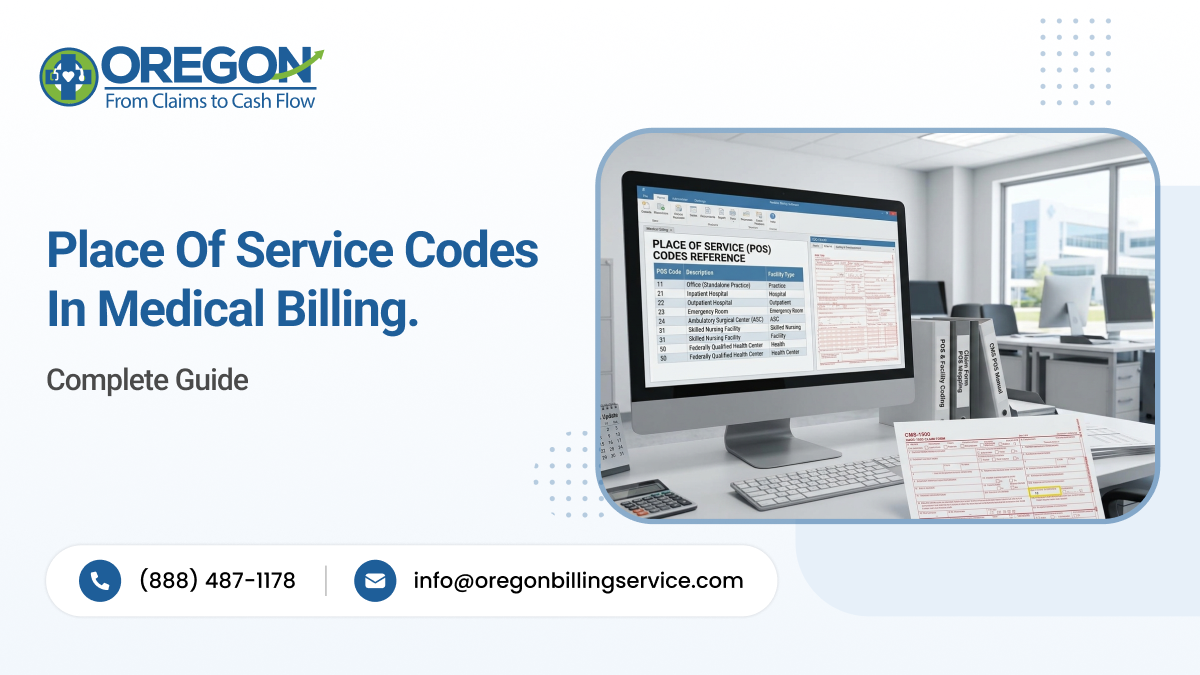
A small POS code can make a big difference in medical billing.
The place of service (POS) code tells the payer where a healthcare service was provided, such as an office, hospital, home, or telehealth setting. CMS maintains the standard POS code set for professional claims. For billing teams, the key is choosing the code that accurately matches the actual setting of care and supports proper claim processing and payment.
Not sure which place of service code fits your claims? We can help review your billing workflow, verify POS coding, identify common errors, and support claim follow-up so your team can bill with greater accuracy and fewer avoidable issues.
Place of Service codes are two-digit codes reported on professional healthcare claims to identify the entity or setting where services were rendered.
CMS notes that the POS code set is used as the national standard for describing sites of service on professional claims.
The POS code is not a CPT code, diagnosis code, or modifier. It answers a different question:
Where did the service take place?
That location needs to make sense with the rest of the claim.
POS coding may look like a small field on a claim, but it can have a broader impact on how a professional service is processed.
| Billing Area | Why POS Matters |
| Claim processing | Identifies the setting where the service occurred |
| Payment methodology | May determine whether facility or non-facility payment logic applies for certain services |
| Telehealth | Distinguishes whether the patient was at home or elsewhere |
| Facility billing | Helps distinguish hospital, SNF, ASC, and other settings |
| Claim accuracy | Keeps the reported setting consistent with the actual encounter |
| Audits and reviews | Provides evidence about where the service was performed |
| Payer rules | Some payers have specific reimbursement policies tied to POS |
Under the Medicare Physician Fee Schedule, some services have separate facility and non-facility rates. CMS states that the POS code is used to identify the setting and can determine which payment rate applies.
That does not mean every POS code automatically changes reimbursement. The effect depends on the service, payment system, and payer rules.
CMS also specifically instructs providers to check individual payer policies regarding POS reimbursement.
Providers do not necessarily need to memorize the entire POS code set, but billing teams should be comfortable with the codes they encounter regularly.
| POS | Place of Service | Typical Setting |
|---|---|---|
| 01 | Pharmacy | Pharmacy location providing healthcare-related items/services |
| 02 | Telehealth, Other Than Patient’s Home | Patient receives telehealth somewhere other than home |
| 10 | Telehealth, Patient’s Home | Patient receives telehealth while at home |
| 11 | Office | Physician or practitioner office |
| 12 | Home | Patient’s private residence |
| 19 | Off-Campus Outpatient Hospital | Hospital outpatient department located off the main campus |
| 20 | Urgent Care Facility | Urgent care setting |
| 21 | Inpatient Hospital | Patient admitted as an inpatient |
| 22 | On-Campus Outpatient Hospital | Hospital outpatient department on the main campus |
| 23 | Emergency Room – Hospital | Hospital emergency department |
| 24 | Ambulatory Surgical Center | Outpatient surgical facility |
| 31 | Skilled Nursing Facility | SNF setting |
| 32 | Nursing Facility | Nursing facility |
| 33 | Custodial Care Facility | Custodial care setting |
| 49 | Independent Clinic | Independent clinic |
| 50 | Federally Qualified Health Center | FQHC |
| 65 | End-Stage Renal Disease Treatment Facility | Dialysis treatment facility |
| 71 | Public Health Clinic | State/local public health clinic |
| 72 | Rural Health Clinic | Certified rural health clinic |
| 81 | Independent Laboratory | Independent laboratory |
| 99 | Other Place of Service | Setting not identified by another POS code |
These descriptions are based on CMS’s current POS code set for professional claims. CMS maintains additional codes for settings such as schools, homeless shelters, assisted living facilities, Indian Health Service facilities, community mental health centers, inpatient psychiatric facilities, hospice, ambulance services, and rehabilitation facilities.
POS 02 and POS 10 are both telehealth codes, but they are not interchangeable.
The difference is the patient’s location.
| Code | Patient Location | Meaning |
|---|---|---|
| POS 02 | Somewhere other than home | Telehealth service provided when the patient is not located in their home |
| POS 10 | Patient’s home | Telehealth service provided when the patient is located in their home |
CMS established POS 10 to distinguish telehealth provided when the patient is at home from telehealth provided at another location.
A physician conducts a video follow-up with a patient who is sitting in their living room.
POS 10 would identify the patient’s home as the telehealth location, subject to the payer’s applicable billing requirements.
Now consider a patient who connects to the same type of virtual visit while at another location, such as a healthcare facility.
The setting is different, so POS 02 may apply when permitted by the payer.
The key question is not:
“Was this a video visit?”
It is:
“Where was the patient when the telehealth service was provided?”
These three codes are especially important for practices connected to hospitals.
| POS | Setting | Key Difference |
| 11 | Office | Routine ambulatory care in an office setting |
| 19 | Off-Campus Outpatient Hospital | Hospital outpatient department located off the main campus |
| 22 | On-Campus Outpatient Hospital | Hospital outpatient department on the hospital’s main campus |
CMS defines POS 19 for an off-campus outpatient hospital setting and POS 22 for an on-campus outpatient hospital setting. POS 11 is used for an office setting that meets CMS’s definition.
Imagine a physician sees patients in three different locations:
Private physician office → POS 11
Hospital outpatient department on the hospital campus → POS 22
Hospital outpatient department at a separate off-campus location → POS 19
The fact that the same physician performed the service does not mean the same POS code should be used for every encounter.
The actual setting of the service matters.
Another common source of confusion is hospital-based care.
Being inside a hospital does not automatically mean the claim should use POS 21.
| POS | Setting | When It Applies |
| 21 | Inpatient Hospital | Patient is receiving inpatient hospital care |
| 22 | On-Campus Outpatient Hospital | Patient receives outpatient services on the hospital campus |
| 23 | Emergency Room – Hospital | Service is provided in the hospital emergency department |
The difference is based on the type of setting and encounter, not simply the physical building. CMS maintains separate definitions for inpatient hospital, outpatient hospital, and emergency room services.
A patient is admitted to the hospital and receives a professional service as an inpatient.
POS 21
The patient comes to the hospital for a scheduled outpatient service.
POS 22
The patient receives care in the hospital emergency department.
POS 23
That distinction should be reflected accurately on the professional claim.
Nursing-related settings can also create confusion because the names sound similar.
| POS | Place of Service | Basic Distinction |
| 31 | Skilled Nursing Facility | Inpatient skilled nursing/rehabilitative setting |
| 32 | Nursing Facility | Nursing facility setting |
| 33 | Custodial Care Facility | Custodial care setting |
The correct code depends on the actual facility and the services being provided. CMS maintains separate POS definitions for these settings.
A biller should therefore avoid choosing a code based only on the word “nursing” appearing in the facility’s name.
Choosing a POS code becomes much easier when the billing team follows the same process for every claim.
Start with the actual location of the encounter.
Do not automatically use the provider’s primary office location.
A physician may have one NPI and practice at several locations, each with a different POS.
For telehealth, determine where the patient was located.
If the patient was at home, POS 10 may apply.
If the patient was somewhere other than home, POS 02 may apply, depending on the payer’s requirements.
Ask:
Do not rely solely on what the location is called internally.
Compare the actual setting with the CMS POS definition.
CMS specifically advises providers to check individual payer policies regarding POS codes and reimbursement.
This matters because Medicare, Medicaid programs, and commercial insurers can have different reimbursement rules.
The POS should make sense alongside:
A POS code should tell the same story as the rest of the claim.
POS codes are used on professional claims to identify where the service was rendered.
For electronic professional claims, the POS code is part of the standard claim data used to describe the site of service. CMS identifies the POS code set as the national standard for professional claims.
The code is also associated with the service line rather than being treated as a diagnosis or procedure code.
That distinction matters because changing the POS does not change the underlying CPT code.
For example:
CPT = What service was performed?
ICD-10-CM = Why was it performed?
POS = Where was it performed?
These elements work together to describe the claim.
It can.
Under the Medicare Physician Fee Schedule, certain professional services have separate facility and non-facility payment rates. CMS explains that POS is used to identify the setting and can determine which rate applies.
Generally, the difference reflects where the resources associated with the professional service are incurred.
For example, Medicare’s Physician Fee Schedule generally pays most office-based physician services using a rate that includes the resources required to furnish the service in the office. Facility-setting rates generally reflect that the facility is supplying certain resources separately.
An incorrect POS can therefore create more than a data-quality issue.
Depending on the service and payer, it can contribute to:
CMS has specifically identified incorrect facility-versus-non-facility reimbursement as a claim-review issue.
However, billing teams should not assume that changing a POS automatically changes payment. The applicable service, payer, fee schedule, and reimbursement policy all matter.
A provider may routinely see patients in an office, but that does not mean every ambulatory location is POS 11.
Hospital outpatient departments may require POS 19 or 22 depending on their location and classification.
Both represent telehealth, but the patient’s location is different.
Patient at home → POS 10
Patient somewhere other than home → POS 02
Subject to applicable payer requirements.
POS 21 represents an inpatient hospital setting.
An outpatient hospital encounter may instead require POS 19 or 22.
The distinction is whether the outpatient hospital department is off campus or on campus.
SNF and nursing facility are not interchangeable POS definitions.
POS 99 means Other Place of Service, a setting not identified by another POS code.
It should not become a convenient substitute for researching an unclear location.
A POS code can be technically valid under the CMS code set while still being subject to additional payer reimbursement requirements.
Think about the claim as a story.
The CPT code says what happened.
The diagnosis code helps explain why it happened.
The POS code says where it happened.
If those pieces do not agree, the payer may have questions.
For example:
Documentation: Patient seen in hospital outpatient department
Claim POS: Office
The CPT code might be completely correct, but the reported setting does not match the encounter.
That mismatch can lead to claim rework, payment discrepancies, or additional review depending on the payer and service.
Actual service location
↓
Identify the correct POS category
↓
Verify CMS definition
↓
Check payer policy
↓
Compare POS with CPT, modifiers, and documentation
↓
Submit claim
This simple workflow can prevent POS selection from becoming an after-the-fact correction.
For quick reference:
| Scenario | Potential POS |
| Telehealth, patient at home | 10 |
| Telehealth, patient somewhere other than home | 02 |
| In-person service in patient’s home | 12 |
| Routine office visit | 11 |
| On-campus hospital outpatient service | 22 |
| Off-campus hospital outpatient service | 19 |
| Inpatient hospital service | 21 |
| Hospital emergency department service | 23 |
| Ambulatory surgical center | 24 |
| Skilled nursing facility | 31 |
| Nursing facility | 32 |
These are CMS-defined settings, but the final claim should always be checked against the applicable payer’s billing requirements.
CMS’s POS code set contains many more settings than the codes most physician practices use every day.
| POS | Place of Service |
|---|---|
| 01 | Pharmacy |
| 02 | Telehealth Provided Other Than in Patient’s Home |
| 03 | School |
| 04 | Homeless Shelter |
| 05 | Indian Health Service Free-Standing Facility |
| 06 | Indian Health Service Provider-Based Facility |
| 07 | Tribal 638 Free-Standing Facility |
| 08 | Tribal 638 Provider-Based Facility |
| 09 | Prison/Correctional Facility |
| 10 | Telehealth Provided in Patient’s Home |
| 11 | Office |
| 12 | Home |
| 13 | Assisted Living Facility |
| 14 | Group Home |
| 15 | Mobile Unit |
| 16 | Temporary Lodging |
| 19 | Off-Campus Outpatient Hospital |
| 20 | Urgent Care Facility |
| 21 | Inpatient Hospital |
| 22 | On-Campus Outpatient Hospital |
| 23 | Emergency Room – Hospital |
| 24 | Ambulatory Surgical Center |
| 25 | Birthing Center |
| 26 | Military Treatment Facility |
| 31 | Skilled Nursing Facility |
| 32 | Nursing Facility |
| 33 | Custodial Care Facility |
| 34 | Hospice |
| 41 | Ambulance – Land |
| 42 | Ambulance – Air or Water |
| 49 | Independent Clinic |
| 50 | Federally Qualified Health Center |
| 51 | Inpatient Psychiatric Facility |
| 52 | Psychiatric Facility – Partial Hospitalization |
| 53 | Community Mental Health Center |
| 54 | Intermediate Care Facility/Individuals with Intellectual Disabilities |
| 55 | Residential Substance Abuse Treatment Facility |
| 56 | Psychiatric Residential Treatment Center |
| 57 | Non-Residential Substance Abuse Treatment Facility |
| 58 | Non-Residential Opioid Treatment Facility |
| 60 | Mass Immunization Center |
| 61 | Comprehensive Inpatient Rehabilitation Facility |
| 62 | Comprehensive Outpatient Rehabilitation Facility |
| 65 | End-Stage Renal Disease Treatment Facility |
| 66 | PACE Center |
| 71 | Public Health Clinic |
| 72 | Rural Health Clinic |
| 81 | Independent Laboratory |
| 99 | Other Place of Service |
CMS’s current code-set page notes that some numeric ranges are unassigned and provides the formal descriptions for the active codes.
For production billing, teams should use the current CMS code set and applicable payer guidance rather than relying on a static online list.
CMS’s main Place of Service page was updated in February 2026, and the POS code-set page was also updated in February 2026.
However, the code-set database displayed by CMS is identified as updated May 2, 2024. CMS continues to maintain the page and directs billing questions to the applicable Medicare Administrative Contractor.
The practical takeaway for providers is not to assume that a POS code list found online is permanently current.
Before submitting claims, billing teams should verify:
This is especially important when a practice adds a new location, begins telehealth, moves into a hospital-owned facility, or changes its billing arrangement.
Before submitting a professional claim, ask:
A few seconds spent verifying the location can be much cheaper than correcting a claim after submission.
What is a POS code in medical billing?
A POS code is a two-digit code used on professional claims to identify where a healthcare service was provided. CMS maintains the national POS code set.
What does POS 11 mean?
POS 11 means Office. It represents a location where a healthcare professional routinely provides ambulatory examinations, diagnosis, and treatment, outside the facility types excluded by CMS’s definition.
What is POS 22?
POS 22 means On-Campus Outpatient Hospital. It is used for outpatient hospital services provided on the hospital’s main campus when the CMS definition applies.
What is the difference between POS 19 and POS 22?
Both represent outpatient hospital settings. POS 19 is for an off-campus outpatient hospital, while POS 22 is for an on-campus outpatient hospital.
What is POS 02 vs. POS 10?
POS 02 is telehealth when the patient is not at home. POS 10 is telehealth when the patient is at home.
Does POS affect Medicare reimbursement?
It can. For certain services under the Medicare Physician Fee Schedule, POS helps determine whether facility or non-facility payment rates apply. The exact effect depends on the service and applicable payment rules.
Can the same provider use different POS codes?
Yes. A provider can use different POS codes when services are furnished in different settings. The POS should represent the actual setting of the service and comply with the payer’s requirements.
Is POS 99 a general code for an unknown location?
No. POS 99 means Other Place of Service, a setting not identified by another POS code. It should not simply be used because the billing team has not determined the correct setting.
Oregon Billing Services can help with billing, coding, claims, denials, A/R, and revenue cycle management.