Tick Bite ICD-10 Code: How to Choose the Right Code for the Encounter
August 27, 2026
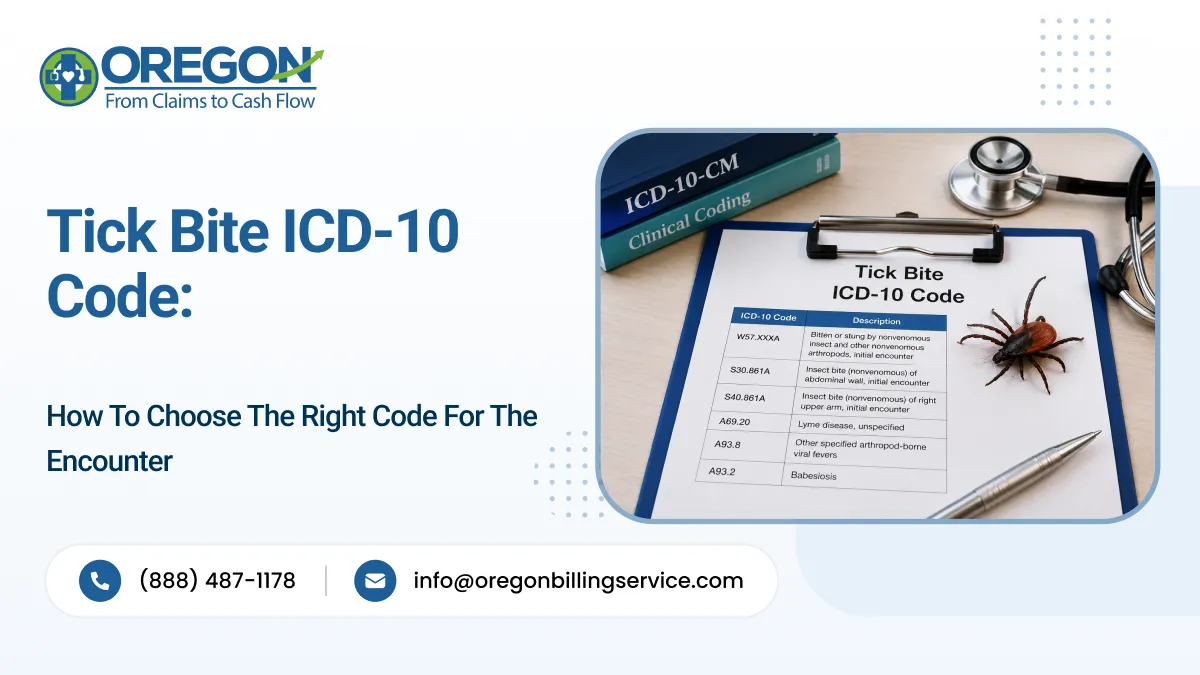
A tick bite may seem like a simple diagnosis, but ICD-10-CM coding isn’t quite that simple. The correct code depends on what happened, where the patient was bitten, and what the provider documented during the encounter.
An inaccurate code can create confusion for the providers getting the right ICD-10-CM codes therefore documenting it the right way is very important, that clearly supports the diagnosis.
In the guide, we will explore how providers may choose the proper ICD-10-CM code for tick bite, how they can prevent denials and how they can fix before the claim gets denied.
Most encounters in which a tick bite is documented include an appropriate ICD-10-CM code from the S00–S99 injury chapter based on the location of the bite.
The code also depends on whether the encounter is:
For example, a tick bite unspecified region of body may be categorized substantially differently than a tick bite of scalp, neck, trunk or limb.
This means there is not a single uniform “tick bite ICD-10 code” for all patients.
The provider’s documentation needs to provide enough to the developer to know the correct site and encounter type.
The very first details that a provider checks while selecting a tick bite ICD-10-CM code is the location of the bite. The FY 2026 code set provides site-specific codes for different parts of the body.
The final character or characters depend on the specific code and encounter circumstances. Always verify the current ICD-10-CM code set before submitting the claim.
The ICD-10-CM code selection is based on the specific site of a tick bite. A generic statement that there was a tick bite may not be sufficient to determine the appropriate injury code.
For example, documentation such as:
“Seen today for a tick bite.”
confirms the reason for the visit but leaves the affected body area unclear.
A more useful entry would be:
“Tick bite noted on the posterior scalp.”
This gives the coder the anatomical information needed to narrow down the appropriate code category.
When documenting a tick bite, clearly record:
Clear anatomical documentation reduces guesswork and helps prevent the use of an unspecified code when a more accurate option is available.
Coding takeaway: Instead of recording only that a tick bite occurred, identify the affected body region as precisely as the clinical findings allow.
Sometimes the provider genuinely does not know or document the exact location.
At times the provider cannot document the specific location of the tick-bite. Then an unspecified-site code can be a good choice, if supported by the documentation. Just because the location check was missing, it shouldn’t repeat over and over again.
If the provider can identify the site, documenting it gives the coding team the information needed to select a more specific code.
The aim is not to avoid undefined codes at any cost. The idea is to utilize the most specific code that the medical record will support.
Another part of tick bite coding that can cause confusion is the 7th character. For injury codes, the encounter character generally indicates the stage of care.
The initial encounter is generally used while the patient is receiving active treatment for the injury.
For example, a patient comes to the office shortly after discovering a tick bite and receives evaluation and treatment.
A subsequent encounter is generally used when the patient is receiving routine care during the healing or recovery phase.
A sequela represents a condition resulting from the original injury after the acute phase has ended.
This distinction is important because “initial” does not simply mean the first time this patient has ever seen this provider.
It refers to the phase of treatment.
This is where clinical documentation becomes especially useful.
If the patient arrives with an attached tick, document what was found and what was done.
Depending on the circumstances, the note may include:
Do not assume that every tick encounter should be coded only as a “tick bite.”
The actual reason for the encounter and the conditions documented by the provider should guide code selection.
Not necessarily.
Finding a tick on clothing is different from having a tick attached to the skin. The provider should document what was found, where it was found, and what was treated.
For example:
“Tick attached to left lower leg; removed in office. Mild redness noted.”
This gives the coding team more information than simply documenting “tick exposure.”
A tick bite and Lyme disease are not the same diagnosis.
A patient may be evaluated after a tick bite without having Lyme disease.
If Lyme disease is diagnosed the providers should document it right away with the appropriate ICD-10-CM and the diagnosis taking into account the clinical situations.
This distinction matters because coding a disease that has not been diagnosed simply because a tick was involved can create an inaccurate medical record and potentially affect claim processing.
The same principle applies to other tick-borne illnesses.
Do not code the suspected disease simply because the patient had a tick bite unless the provider’s documentation supports the diagnosis and the applicable coding guidelines allow it.
These two situations should not be treated as interchangeable.
The patient presents because they were bitten by a tick or had an attached tick removed.
The documentation focuses on the bite, exposure, examination, treatment, and follow-up.
The patient has a diagnosed condition associated with tick exposure, such as Lyme disease or another documented tick-borne infection.
The diagnosis and corresponding disease code become important.
A patient can also have both a tick bite and a diagnosed tick-borne disease. In that situation, code selection should follow the applicable ICD-10-CM guidelines and the provider’s documentation.
Good coding starts with a useful clinical note.
For a tick bite encounter, consider documenting:
Not every item will apply to every encounter.
Tick bite claims can run into problems when the documentation and code do not line up.
There is no single code that fits every tick bite.
The anatomical site and encounter details matter.
When the provider identifies the location for the tick, ICD-10-CM code should be more specific to the diagnosis.
A tick bite does not automatically mean the patient has Lyme disease. Using the right code based on the diagnosed medical condition supported by a medical record.
The 7th character is based on the stage of treatment, not simply whether the patient is new to the practice.
Medication or treatment alone does not necessarily establish a diagnosis.
The provider’s documented diagnosis and clinical findings should support the code selection.
A few extra words in the clinical note can save a lot of back-and-forth later.
Instead of documenting:
“Tick bite. Removed.”
Consider documenting the relevant details:
“Attached tick removed from the posterior scalp. Mild localized erythema noted. The patient denies fever or systemic symptoms. Wound care and follow-up instructions provided.”
That gives the coding team a much clearer picture of the encounter.
It also creates a better clinical record for anyone who sees the patient later.
A routine tick bite may be straightforward, but additional review can be useful when:
In these situations, guessing at the code can create more problems than taking a moment to review the documentation.
What is the ICD-10 code for a tick bite?
There is no single code for every tick bite. ICD-10-CM code selection depends on the anatomical site and encounter circumstances
What is the ICD-10 code for an unspecified tick bite?
An unspecified-site tick bite code may be used when the documentation does not identify the anatomical location. such as T14.8XXA or S00.96XA.
A provider can use an unspecified-site tick bite code only when the documentation does not identify the anatomical location.
Is a tick bite the same as Lyme disease for coding?
No. A tick bite does not establish a diagnosis of Lyme disease. Lyme disease should be coded when the provider documents the diagnosis and the coding guidelines support reporting it.
Does the tick bite code require a 7th character?
Applicable injury codes may require a 7th character to identify the encounter type. The correct character depends on whether the patient is receiving active treatment, subsequent care, or treatment for a sequela.
Should the tick bite location be documented?
Yes. Documenting the anatomical location helps the coding team determine whether a more specific ICD-10-CM code is available.
Tick bite coding looks simple until the details start to matter. Where the bite occurred, what the provider found, what treatment was given, and whether a tick-borne disease was actually diagnosed can all affect the final code.
For providers, the best approach is straightforward: document the encounter clearly and let the medical record support the level of coding specificity. When the documentation and diagnosis line up, the billing process becomes much easier.
Oregon Billing Service helps healthcare providers improve coding accuracy, reduce denials, and keep their revenue cycle running smoothly.