Uncontrolled Type 2 Diabetes ICD-10 Code: What Providers Need to Know
August 28, 2026
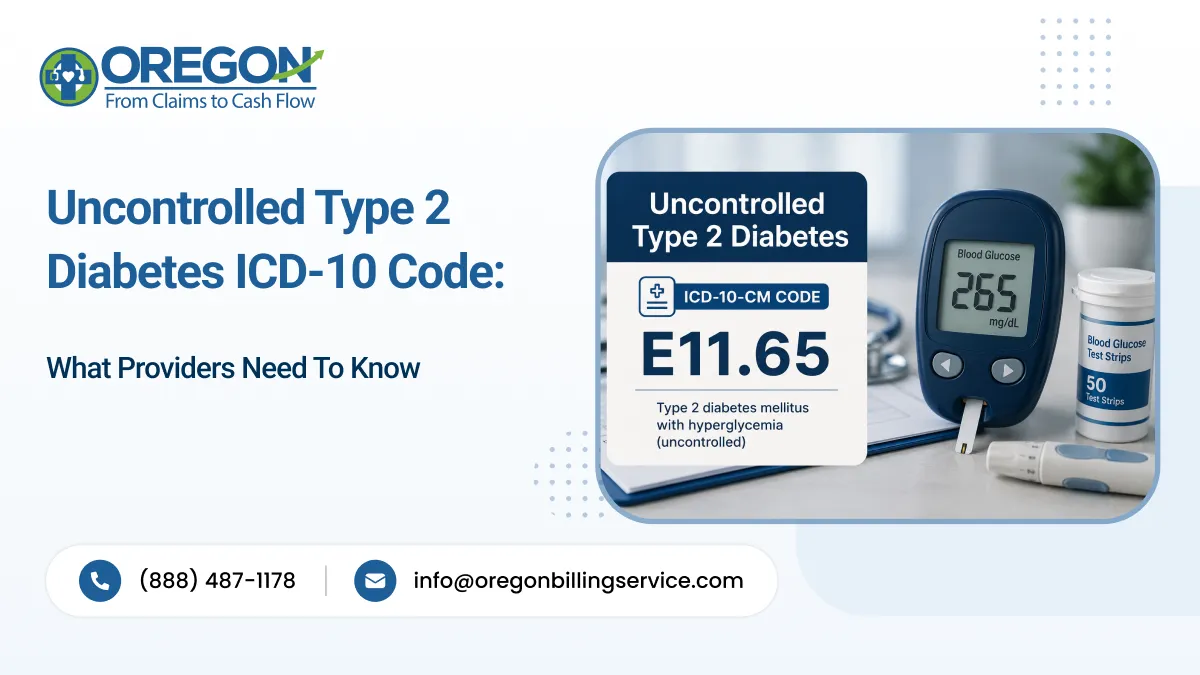
One word in a diabetes note can change how the claim is coded.
“Uncontrolled” is a term providers use often, but it does not automatically tell a coder which ICD-10-CM code to report. When type 2 diabetes is documented with hyperglycemia, E11.65 is generally the code to consider. The challenge is making sure the documentation, diagnosis code, and claim all tell the same story.
In this guide, we’ll break down the type 2 diabetes uncontrolled ICD-10 coding, when E11.65 applies, what documentation matters, and how coding or authorization issues can affect billing.
E11.65 — Type 2 diabetes mellitus with hyperglycemia is generally the code to consider when a provider documents type 2 diabetes as poorly controlled and the record supports hyperglycemia. Simply writing “uncontrolled diabetes” is not enough on its own the coder should look at the full clinical picture and supporting documentation before choosing the code.
The conclusion is that “uncontrolled diabetes” is not an ICD-10-CM code description at this time. The coding notion is represented by the correct diabetes category and the verified clinical state, such as hyperglycemia. The concept of uncontrolled type 2 diabetes as defined in ICD-9-CM (where hyperglycemia is represented) has previously been linked to E11.65 in CMS documents.
For FY 2026, E11.65 is listed as:
E11.65 specifically describes type 2 diabetes mellitus with hyperglycemia.
Note: E11.65 is only appropriate when poorly controlled or uncontrolled type 2 diabetes is documented with hyperglycemia; always verify the complete clinical documentation before assigning the code.
Older diabetes terminology frequently used phrases such as:
Current ICD-10-CM coding uses more specific clinical classifications. That means the coder needs to determine what the provider actually documented and what condition is being treated.
For example:
Provider documentation: “Type 2 diabetes mellitus, poorly controlled, with persistent hyperglycemia.”
The documentation supports evaluating E11.65.
Compare that with:
Provider documentation: “Type 2 diabetes mellitus without complications; glucose currently controlled.”
That does not support automatically reporting E11.65.
No.
E11.9 represents type 2 diabetes mellitus without complications, while E11.65 represents type 2 diabetes with hyperglycemia.
What providers and coders do wrong is use E11.9 as a default for every encounter with type 2 diabetes.
Consider these examples:
| Documentation | Code to Evaluate |
|---|---|
| Type 2 diabetes without complications | E11.9 |
| Type 2 diabetes with hyperglycemia | E11.65 |
| Type 2 diabetes with diabetic CKD | E11.22 + CKD code |
| Type 2 diabetes with neuropathy | E11.4- |
| Type 2 diabetes with hypoglycemia (no coma) | E11.649 |
| Type 2 diabetes with ketoacidosis (no coma) | E11.10 |
| Type 2 diabetes with hyperosmolarity (no coma) | E11.00 |
The exact code depends on the documented condition and the applicable ICD-10-CM guidelines.
A concise documentation gives a coder enough information, explaining the diabetes type, the current medical condition and complications
For an encounter involving uncontrolled type 2 diabetes, documentation may include:
A laboratory result by itself should not be treated as a substitute for provider documentation of the diagnosis.
This difference is important especially during medical review. The core purpose explained by CMS is that medical reviews examine records to determine whether services follow the applicable coverage, coding, billing, and medical-necessity requirements.
The core explained by
A patient’s laboratory report shows an elevated glucose level.
The provider documents:
“Type 2 diabetes mellitus with hyperglycemia; adjusting medication due to poor glycemic control.”
That documentation supports the coding review for E11.65.
But if the laboratory report contains an elevated glucose value and the provider only documents:
“Type 2 diabetes mellitus.”
The coder should not independently convert the laboratory result into a provider diagnosis of uncontrolled diabetes.
E11.65 is only one code within the type 2 diabetes category.
The patient’s actual condition determines which code or combination of codes should be reported.
This is the key code associated with the primary search term type 2 diabetes uncontrolled ICD 10.
It identifies type 2 diabetes with hyperglycemia.
E11.9 should not automatically replace E11.65 simply because the provider documents type 2 diabetes.
If hyperglycemia is documented, the coder needs to evaluate whether E11.65 is supported.
E11.8 describes type 2 diabetes with an unspecified complication. It should not be used simply because diabetes is difficult to control.
The documentation should support the presence of a complication.
Diabetic kidney disease may require a more specific E11.2- code along with the applicable kidney disease code when required.
If documentation establishes diabetic neuropathy or another neurological complication, the appropriate E11.4- code should be evaluated.
This category covers several specified complications, including certain diabetic skin, oral, circulatory, and other conditions.
Hyperosmolarity is clinically different from ordinary hyperglycemia and should not simply be coded as E11.65 when the documentation supports hyperosmolarity.
Likewise, diabetic ketoacidosis has its own coding pathway and should not be reduced to routine hyperglycemia coding.
Diabetes coding may also involve codes from category Z79 when documentation supports long-term medication use.
The FY 2026 ICD-10-CM Official Guidelines identify:
Accurate diagnosis coding does more than populate the claim form.
Diagnosis codes can help establish the clinical context for services reported on a claim. Depending on the service and payer, diagnosis information may be relevant to:
In healthcare, Prior authorization can affect diabetes-related claims only when a payer requires approval for a medication, device, treatment, or service used to manage the patient’s condition.
Before Permitting a treatment request for a patient with type 2 diabetes with hyperglycemia (E11.65), the payer may examine the patient’s diagnosis, treatment history, clinical records, and medical necessity.
Problems can occur when:
A correctly reported E11.65 does not guarantee authorization or payment. The billing team still needs to follow the specific payer’s authorization requirements and verify that the approved service matches what was actually provided.
Providers and billing teams may have more work to do as a result of prior authorization denials, especially if treatment is postponed or the subsequent claim cannot be handled as anticipated. Instead of just resubmitting the claim in the event of a refusal, the team should ascertain whether the issue was with the authorization, documentation, medical necessity, eligibility, or coding.
For diabetes-related services, a practical review should include:
An abnormal laboratory value does not automatically establish the provider’s diagnosis of uncontrolled diabetes.
Better approach: Review the provider’s assessment and plan and code according to the documented diagnosis and applicable guidelines.
E11.9 represents type 2 diabetes without complications. It should not automatically be used when the provider documents hyperglycemia.
“Uncontrolled” describes the state of the diabetes; it is not a substitute for determining the appropriate ICD-10-CM code.
A patient may have uncontrolled diabetes and a documented complication such as neuropathy or kidney disease.
The coder should review the entire assessment rather than stopping at E11.65.
These are not interchangeable clinical conditions.
When the record documents DKA or hyperosmolarity, the applicable diabetes complication code should be evaluated.
Long-term insulin, oral antidiabetic medication, and injectable non-insulin antidiabetic drug use may require additional Z79 coding when the guidelines support it.
Providers do not need to write lengthy notes solely for coding purposes. The goal is clear, clinically meaningful documentation.
A useful diabetes assessment can identify:
For example:
Assessment: Type 2 diabetes mellitus with hyperglycemia. Glycemic control remains above the patient’s treatment goal despite current therapy. Medication regimen adjusted; follow-up planned.
The exact wording should reflect the provider’s actual clinical judgment and should never be added merely to obtain a particular code.
Documentation:
“Type 2 diabetes mellitus with hyperglycemia. Blood glucose remains above the treatment goal. Medication regimen adjusted.”
Coding consideration:
E11.65 — Type 2 diabetes mellitus with hyperglycemia
The documentation directly supports the hyperglycemia concept.
Documentation:
“Type 2 diabetes mellitus without complications. Continue current management.”
Coding consideration:
E11.9 — Type 2 diabetes mellitus without complications
There is no documented hyperglycemia or other complication supporting E11.65.
Documentation:
“Type 2 diabetes with diabetic CKD, stage 3a.”
The coder should evaluate the applicable diabetes-with-kidney-complication code and the CKD code representing the documented stage.
The important lesson is that the coder should not stop at E11.65 simply because the patient’s glucose is also elevated.
Documentation:
“Type 2 diabetes with hyperglycemia. The patient remains on long-term insulin therapy.”
The coding review may include E11.65 plus the applicable Z79.4 code when long-term insulin use is documented and supported by the FY 2026 guidelines.
A reliable diabetes coding workflow can be built around five checks:
Review whether the provider documents type 1, type 2, secondary diabetes, or another applicable category.
Look for:
Review the assessment for documented:
Determine whether long-term insulin, oral antidiabetic drugs, or injectable non-insulin antidiabetic drugs are documented and whether applicable Z79 codes should be assigned.
Diagnosis coding and payer authorization requirements are related but not identical. A correctly coded diagnosis does not automatically satisfy a payer’s authorization or medical-necessity requirements.
Incorrect diagnosis coding can create problems at multiple points in the revenue cycle.
A mismatch between documentation and the submitted diagnosis can contribute to:
CMS states that medical review is used to ensure payment is made only when claims satisfy applicable coverage, coding, billing, and medical-necessity requirements.
That makes documentation accuracy a revenue-cycle issue—not just a coding issue.
Before submitting a claim, billing and coding teams can ask:
This type of pre-bill review can help identify errors before they become denials.
Avoid relying on vague phrases when the patient’s condition can be documented more precisely.
The diagnosis, treatment plan, clinical findings, and billed service should be internally consistent.
A diabetes diagnosis may involve multiple clinically relevant conditions. Missing a documented complication can lead to incomplete coding.
A correct ICD-10-CM code does not equal prior authorization.
Authorization is a payer process; diagnosis coding is a classification and claim-reporting process.
If a service requires authorization, maintain a reliable record of authorization numbers, dates, approved services, units, and other applicable details.
Instead of simply resubmitting a denied claim, determine why it failed:
This allows the billing team to correct the underlying workflow.
Getting the diabetes code right starts with clear documentation. When the diagnosis, clinical picture, and claim all line up, your billing team has a stronger foundation for accurate coding and fewer avoidable billing issues.
Need support with diabetes coding, claims, denials, or authorization workflows? Our medical billing team helps keep your revenue cycle organized while your providers stay focused on patient care.
Need support with diabetes coding, claims, denials, or authorization workflows? Our medical billing team can help keep your revenue cycle organized while your providers stay focused on patient care.
What is the ICD-10 code for uncontrolled type 2 diabetes?
The ICD-10-CM code generally associated with uncontrolled or poorly controlled type 2 diabetes when hyperglycemia is documented is E11.65 Type 2 diabetes mellitus with hyperglycemia. Code selection should be based on the provider’s documentation and current ICD-10-CM guidelines.
Is E11.65 the same as uncontrolled type 2 diabetes?
E11.65 is the ICD-10-CM code for type 2 diabetes mellitus with hyperglycemia. The term “uncontrolled” is not itself the current code description. When a provider documents poorly controlled type 2 diabetes in a manner that indicates hyperglycemia, E11.65 is generally evaluated.
Should E11.9 be used for uncontrolled type 2 diabetes?
Not automatically. E11.9 represents type 2 diabetes mellitus without complications, while E11.65 represents type 2 diabetes with hyperglycemia. The provider’s documentation determines which code is appropriate.
Can E11.65 be assigned based only on an elevated glucose result?
An elevated laboratory result should not automatically be converted into a provider diagnosis of hyperglycemia for coding. The medical record should support the diagnosis being reported, consistent with applicable coding and documentation requirements.
What additional codes may be reported with type 2 diabetes?
Depending on the documentation, additional codes may identify diabetic complications or long-term use of insulin, oral hypoglycemic drugs, or injectable non-insulin antidiabetic drugs. The FY 2026 guidelines specifically address Z79.4, Z79.84, and Z79.85.
What is authorization in medical billing?
Authorization is a payer review process used to determine whether a requested healthcare service or item meets applicable requirements. Prior authorization generally occurs before the service is provided.