What Is a Revenue Code in Medical Billing? A Guide for Providers
September 8, 2026
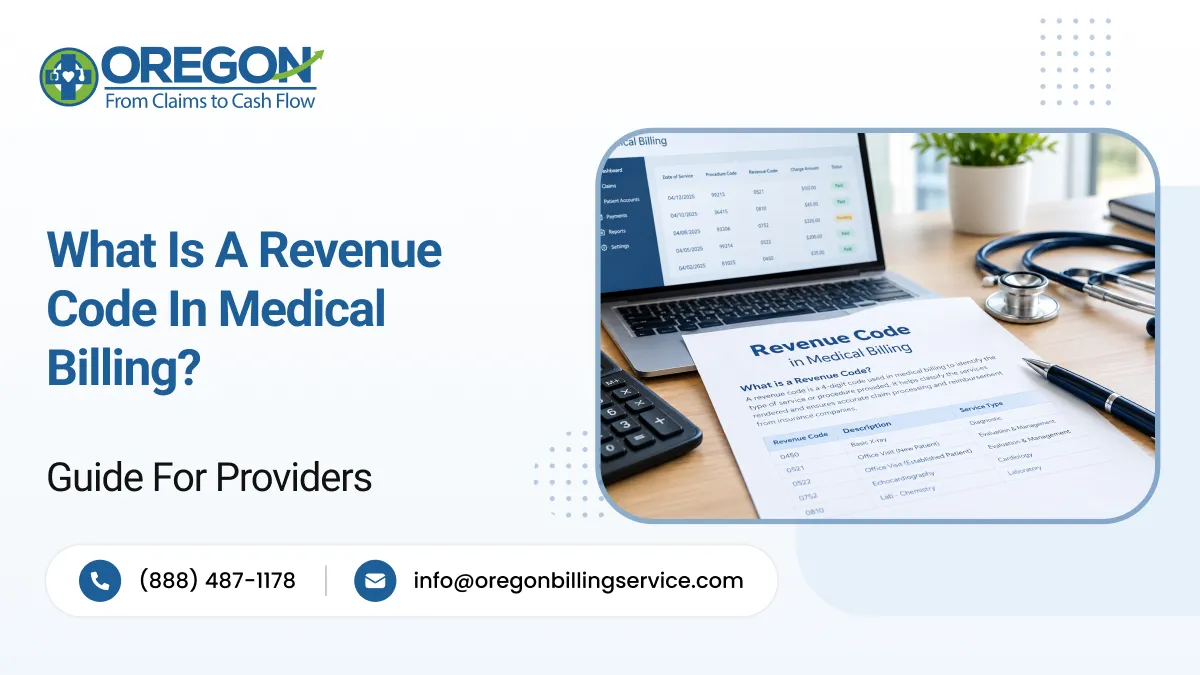
When reviewing a hospital or facility claim, you may see revenue codes alongside CPT, HCPCS, and diagnosis codes. If you’re not familiar with institutional billing, it can be difficult to tell what those numbers represent or why they are included on the claim.
Revenue codes in medical billing identifies the type of facility charge being reported on an institutional claim form. For example, they can indicate charges for laboratory services, emergency-room care, therapy, a patient room, or other facility services. For providers, understanding these codes makes it easier to see how a facility has grouped and reported charges to the payer.
In this guide, we will learn what a revenue code means, where it appears, how it differs from CPT and HCPCS codes, and why accurate reporting matters for facility claims.
In medical billing “Revenue code” is used to identify the charge a healthcare facility reports on the institutional claim. It can point to a department, accommodation, service category, or another type of facility charge.
You’ll usually see revenue codes in medical billing on UB-04 (CMS-1450) and electronic 837I claims. They give the payer a clearer picture of what kind of facility charge is being reported, such as a room, lab service, therapy, or emergency-room charge. The diagnosis and specific service are reported separately through other codes.
For example, a claim may use:
✓
✓
✓
Revenue codes therefore add context to the charge rather than replacing the codes that describe the actual service or diagnosis.
You may not work with revenue-code tables yourself, but these codes can still affect how the services your facility provides are represented on a claim.
An institutional claim brings together several pieces of information. The revenue code helps organize facility charges into categories that the payer can interpret alongside the associated service and claim information.
Accurate reporting can support:
This doesn’t mean a particular revenue code guarantees payment. Reimbursement depends on the complete claim, payer rules, coverage, coding, contracts, and payment methodology.
Revenue codes are primarily associated with institutional billing, rather than the professional claims that many individual physicians are more familiar with.
On the paper CMS-1450 (UB-04), the revenue code is reported in Form Locator 42 (FL 42).
The related charge amount is reported in FL 47.
This allows the claim to connect a charge with the facility category under which it is being reported.
The electronic 837I serves as the electronic format for institutional claims.
Although the electronic claim does not look like a paper UB-04, it carries corresponding institutional claim information, including revenue-code data.
For providers, the practical takeaway is simple: if you’re reviewing an institutional claim, revenue codes are part of the information used to describe the facility’s charges.
Revenue codes and HCPCS codes are not interchangeable. They provide different levels of information about a claim line.
Think about a hospital outpatient service.
The revenue code can identify the facility category associated with the charge, while the HCPCS code can identify the specific service, supply, drug, or other item reported on that line.
For example:
Revenue code
→ Identifies the facility charge category
HCPCS/CPT
→ Identifies the specific service or item
ICD-10-CM
→ Identifies the diagnosis supporting the service
Together, these elements give the payer a more complete picture of what was reported.
Revenue codes and CPT codes describe different aspects of a claim.
A revenue code provides the facility billing context, while a CPT code identifies a specific procedure or service.
For example, a facility may report a revenue category associated with a particular department while using a CPT code to identify the actual procedure performed.
So, revenue codes shouldn’t be viewed as an alternative to CPT coding. They work alongside procedure and service codes on institutional claims.
There are various medical billing revenue codes, Using these codes truly depends on the type of charge and the applicable billing requirements.
Some examples listed in CMS guidance include:
| Revenue Code | General Category |
|---|---|
| 011X | Private-room accommodation |
| 012X | Semi-private-room accommodation |
| 030X | Laboratory |
| 032X | Diagnostic radiology |
| 042X | Physical therapy |
| 043X | Occupational therapy |
| 044X | Speech-language pathology |
| 045X | Emergency room |
| 0636 | Drugs requiring detailed coding |
These examples illustrate an important point: revenue codes generally describe categories of facility charges, not the patient’s diagnosis or the complete details of a procedure.
The 045X revenue-code family is associated with emergency-room services. The revenue code establishes the facility charge category, while the accompanying service codes and other claim information provide additional detail about what was performed.
Revenue code 0636 is used for drugs requiring detailed coding. This is a good example of why providers should not select revenue codes based only on the general description of a service. The applicable coding and billing requirements need to be reviewed together.
Revenue code 0001 is different from the service categories above. CMS describes 0001 as the total of the revenue-center charges on the paper claim. It is reported as the last revenue code on the UB-04 to total the applicable charges.
In other words, 0001 is a total-charge line, not a code representing a particular medical department or service.
A revenue-code line doesn’t exist by itself. It is part of a larger set of information used to describe the charge.
A simplified claim-line view looks like this:
| Claim Information | Purpose |
|---|---|
| Revenue code | Identifies the facility charge category |
| HCPCS/CPT | Identifies the service or item |
| Units | Shows how many units were reported |
| Charge | Shows the amount billed |
| Diagnosis information | Supports the reason for the service |
The exact information required can vary based on the claim type, service, and payer.
For providers reviewing a facility claim, the key question isn’t simply “Is there a revenue code?” It’s whether the information across the claim line makes sense together.
Revenue-code issues can become a problem when the information reported on the claim doesn’t align with the service, charge, or payer requirements.
A revenue code should appropriately represent the type of facility charge being reported. An incorrect category can create inconsistencies within the claim.
The revenue code provides context, while CPT or HCPCS provides service-level detail. These elements should support a consistent description of what was billed.
Revenue codes are particularly relevant to institutional claims. Providers who primarily submit professional claims should not assume that facility and professional billing use the same reporting structure.
Revenue-code requirements can change, and payer instructions can add specific reporting requirements. CMS recommends using current guidance and checking the applicable NUBC information rather than relying on an old revenue-code list.
You don’t necessarily need to memorize revenue-code tables to understand or review an institutional claim.
A practical approach is to:
For Medicare claims, providers should use current CMS guidance and the applicable NUBC revenue-code information.
When reviewing a facility claim, look at the revenue code together with the other information reported on that claim line. The goal is to make sure the charge, service, and facility category all make sense together.
For example, if a hospital claim includes a laboratory charge, you can review:
Revenue codes are essentially part of the facility-side language of an institutional claim.
Revenue codes give the payer an idea of what type of charge is being reported. Other codes fill in the details CPT and HCPCS codes describe the service or item provided, while the ICD-10-CM code shows the diagnosis related to the care.
Memorizing every revenue code isn’t important, what matters the most is knowing what these codes do and understanding how they fit with the rest of the claim.
Revenue codes help show how a facility charge is being reported on an institutional claim. They work alongside CPT, HCPCS, and ICD-10-CM codes to give the payer a clearer picture of the service, charge, and diagnosis.
For the healthcare providers, memorizing the revenue code isn’t necessary, what matters most is you should know where revenue codes appear, what they represent, and whether the information on a claim line fits together correctly.
What is a revenue code in medical billing?
A revenue code identifies the category of a charge reported by a healthcare facility on an institutional claim. It may relate to a room, laboratory, therapy, emergency department, or another facility service.
Where are revenue codes used?
Revenue codes are primarily used on institutional claims, including the UB-04 (CMS-1450) and electronic 837I claims. They are not typically used in the same way on professional claims.
What is the difference between a revenue code and a CPT code?
A revenue code shows the facility charge category, while a CPT code identifies a specific procedure or service. They can appear together on an institutional claim but serve different purposes.
What is the difference between a revenue code and a HCPCS code?
Revenue codes provide context about the facility charge, while HCPCS codes identify the specific service, drug, supply, or other item being reported.
What is revenue code 0001?
Revenue code 0001 is used as a total-charge line on the UB-04. It totals the applicable revenue-center charges rather than identifying a particular service or department.
What does revenue code 045X mean?
The 045X revenue-code family is associated with emergency-room services. The related CPT or HCPCS code and other claim information provide more detail about the care reported.
What is revenue code 0636?
Revenue code 0636 is used for drugs that require detailed coding. The appropriate service and drug-related coding requirements should be reviewed along with the revenue code.
Do all medical claims use revenue codes?
No. Revenue codes are primarily associated with institutional claims, such as hospital and other facility claims. Professional claims follow a different billing structure.
Medical billing can become another task competing for your attention when you’re already focused on caring for patients and running your practice. Claims need to be submitted correctly, payer requirements need to be followed, and billing issues need to be addressed when something goes wrong.
That’s where Oregon Billing Service can step in. We work with healthcare providers to handle the day-to-day billing work, from claim submission and follow-up to resolving issues that can slow down reimbursement. The goal is simple: give your practice dependable billing support without adding more work to your plate.
Make Medical Billing One Less Thing to Worry About
Managing claims, payer requirements, and billing follow-up can take time away from your practice. Oregon Billing Service can help handle the day-to-day billing work so you can spend more time focused on your patients.