What Is an Entity Code in Medical Billing? A Provider Guide
September 2, 2026
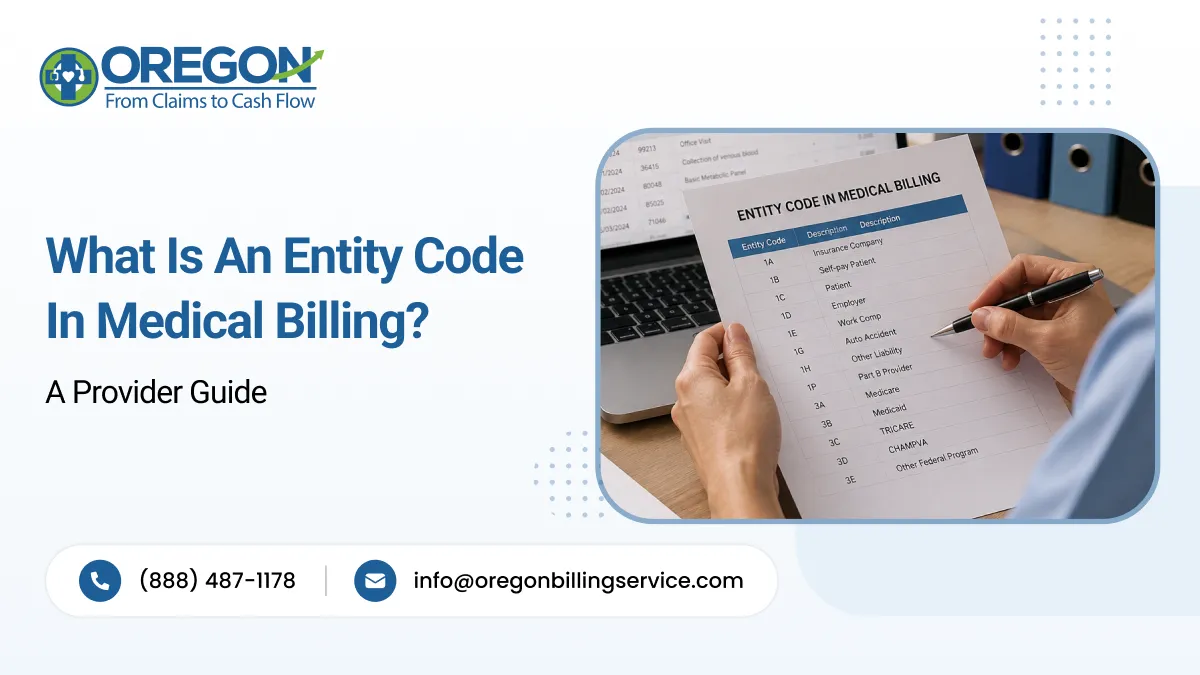
In medical billing, “entity code” can refer to different identifiers depending on the claim format or billing context. In electronic claims, an Entity Identifier Code identifies the role of a person or organization within the transaction, such as the billing provider or rendering provider. A Healthcare Provider Taxonomy Code is different: it classifies a provider by provider type, classification, and specialization.
For providers and billing teams, understanding this distinction is important because the NPI, taxonomy code, payer enrollment information, and claim-level entity information all serve different purposes.
In medical billing, the term “entity code” can have different meanings depending on the claim format and billing context. In an electronic 837 claim, an Entity Identifier Code identifies the role of a person or organization in the transaction. A Healthcare Provider Taxonomy Code is different: it classifies a provider by type, classification, and specialization.
Healthcare providers are classified using the Healthcare Provider Taxonomy Code Set, which is maintained by the National Uniform Claim Committee (NUCC). These codes identify:
A provider taxonomy code is a 10-character alphanumeric code, such as 207R00000X (example: internal medicine physician).
On an electronic 837 healthcare claim, an Entity Identifier Code helps identify the role of the person or organization represented in a particular claim segment. For example, the NM1 segment can identify the billing provider, rendering provider, payer, or another party involved in the transaction.
NM1*85*2*ABC MEDICAL GROUP***XX*1234567890
Here:
The exact NM1 loop, entity code, and required fields depend on the party being identified and the applicable 837 implementation guide or payer requirements. Billing teams should therefore verify the claim against the appropriate transaction and payer specifications rather than assuming every entity uses the same code.
Then focus on practical consequences:
Incorrect billing or rendering provider information can prevent a payer from correctly processing the claim.
Claim information should be consistent with the provider information maintained by the payer.
Electronic claims can be rejected when required provider information is missing, invalid, or inconsistent.
Group practices need to distinguish between the organization billing for the service and the individual who rendered it.
When provider identifiers are maintained consistently, billing teams can identify the source of claim errors more quickly.
The practice maintains provider information such as the billing provider, rendering provider, NPI, taxonomy, location, and payer enrollment details in its billing system.
The billing system places the appropriate provider and entity information into the applicable claim loops and segments.
The claim may be checked for missing, invalid, or inconsistent provider information before or during payer processing.
If the claim passes required edits, it continues through adjudication. If required information is invalid or inconsistent, the claim may be rejected or denied depending on where the issue is identified.
Healthcare providers have multiple identifiers, and confusion between them causes billing errors. Here’s how entity codes relate to other key identifiers:
Entity Code vs. NPI: What’s the Difference?
An NPI is a unique 10-digit identifier assigned to a healthcare provider or organization. A taxonomy code describes the provider’s classification and specialization. An Entity Identifier Code serves a different purpose within an electronic transaction by identifying the role of the entity in that transaction.
Billing teams encounter these entity code mistakes repeatedly:
A physician trained in internal medicine but billing with a pediatrics entity code. Payers reject this because the entity code doesn’t match the provider’s actual credentials.
Impact: Claim rejection with “Provider specialty code invalid” error.
Prevention: Verify each provider’s current specialty with their National Plan & Provider Enumeration System (NPPES) record and ensure billing systems match.
A provider retires or changes specialty, but the practice continues using an old entity code. The code may be invalid or no longer match the provider’s NPPES record.
Impact: Rejection due to “Provider entity code not found” or claims processed under the wrong specialty.
Prevention: Annually audit provider records in NPPES and update internal systems when specialties or credentials change.
The entity code and NPI submitted on a claim belong to different providers or don’t align with payer records.
Impact: Claim rejected as “Provider information mismatch” or held for manual review.
Prevention: Maintain an internal database linking each provider’s NPI to their correct entity code; run periodic audits to catch mismatches.
Then separate the process:
Verify:
Verify that the payer has the correct provider/group information.
Compare the information stored in the practice management system with current provider records.
Review the actual claim that generated the rejection not just the provider’s master record.
When a claim is rejected due to an entity code error, follow these steps:
Review the clearinghouse or payer’s rejection/denial message and identify whether the issue involves the billing provider, rendering provider, NPI, taxonomy, enrollment, or another provider-data element.
Pull up:
Identify where the discrepancy is.
Resubmit once you’ve resolved the underlying issue. Keep documentation of what was corrected for your compliance records.
Create a spreadsheet or billing system report that includes:
Update this database annually or whenever provider credentials change.
Don’t rely on old records. Periodically verify active providers in NPPES to catch:
During credentialing and re-credentialing:
Medical billers should understand:
Use billing software with built-in validation to flag entity code issues before claim submission:
Track entity code rejections separately:
Large practices with multiple locations or separate billing entities face additional complexity.
Understanding entity information starts with knowing which identifier you are actually dealing with. Entity Identifier Codes, NPIs, taxonomy codes, and tax IDs serve different purposes, and confusing them can make claim troubleshooting more difficult.
For providers, the goal is simple: keep provider information consistent across your billing system, NPPES records, payer enrollment files, and claims so your billing team can identify and correct errors before they become recurring revenue-cycle problems.
Oregon Billing Service helps providers manage claims, denials, A/R, coding, and revenue cycle tasks.
No. An Entity Identifier Code identifies a party’s role in an electronic claim, while a taxonomy code identifies a provider’s classification and specialization.
Where is the entity identifier code found on an 837 claim?
It is typically found in the NM1 segment, where it identifies the role of the party being reported, such as the billing or rendering provider.
What is the difference between an entity identifier code and an entity type qualifier?
The Entity Identifier Code identifies the party’s role in the transaction. The Entity Type Qualifier indicates whether that party is an individual or an organization.
Is an NPI the same as an entity code?
No. An NPI is a unique identifier for a provider or organization. An Entity Identifier Code describes the party’s role within the electronic transaction.
What should I check if the billing and rendering provider information does not match?
Review the submitted claim, billing-system provider setup, NPI information, taxonomy, and payer enrollment records. Correct the source of the mismatch before resubmitting the claim.
Can a provider have multiple taxonomy codes?
Yes. A provider can have more than one taxonomy code when applicable, with one designated as the primary taxonomy in NPPES. Practices should make sure the taxonomy information they use is appropriate for the provider and consistent with applicable payer and enrollment records.